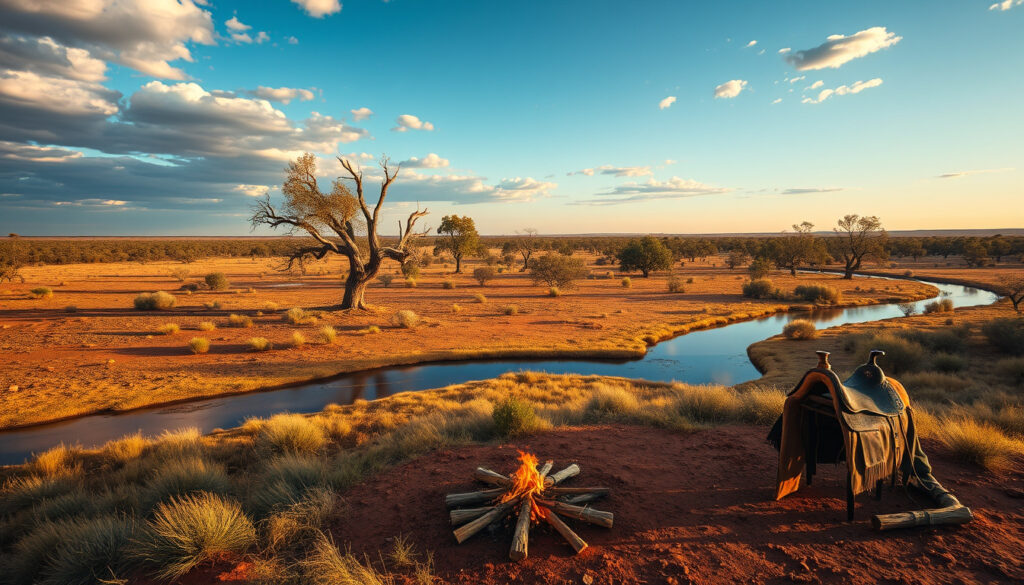
Banjo Paterson: Australia’s Most Famous Bush Poet
There’s a reason Australians still gather around campfires to sing “Waltzing Matilda” more than a century after it was written. Banjo Paterson, the country’s most beloved bush poet, turned the rough frontier life of drovers and swagmen into a national mythology.
Born: 17 February 1864 ·
Died: 5 February 1941 (aged 76) ·
Most famous work: “Waltzing Matilda” ·
Pen name origin: Racehorse Banjo ·
Occupation: Bush poet, journalist, solicitor, war correspondent
Quick snapshot
- Born 17 February 1864 near Orange, NSW (Encyclopaedia Britannica)
- Pen name “Banjo” came from a racehorse owned by his family (State Library of New South Wales)
- Wrote “Waltzing Matilda” in 1895 (Encyclopaedia Britannica)
- Died of a heart attack in Sydney on 5 February 1941 (Encyclopaedia Britannica)
- Exact inspiration for the lyrics of “Waltzing Matilda” remains debated (National Film and Sound Archive of Australia)
- Whether Paterson intended the poem to become a folk song is uncertain (National Film and Sound Archive of Australia)
- Some details of his earliest childhood at Buckenbah are fragmentary (National Film and Sound Archive of Australia)
- The exact timeline of his earliest publications in The Bulletin is not fully documented (National Film and Sound Archive of Australia)
- 1885: First poems published in The Bulletin under “Banjo” (Encyclopaedia Britannica)
- 1890: “The Man from Snowy River” published (Wikipedia)
- 1895: “Waltzing Matilda” published (Encyclopaedia Britannica)
- 1914–1918: War correspondent in WWI (Waltzing Matilda Centre)
- Annual Banjo Paterson Festival continues in Orange, NSW
- His works remain in school curricula across Australia
- Image appears on the Australian $10 note
Six key facts, one pattern: Paterson’s life spanned the transformation of Australia from a collection of colonies to a nation, and his work mirrored that shift.
| Label | Value |
|---|---|
| Birthplace | Narrambla, New South Wales, Australia |
| Occupation | Bush poet, journalist, solicitor, war correspondent |
| Date of death | 5 February 1941 (aged 76) |
| Cause of death | Heart attack |
| Spouse | Alice Emily Walker (married 1903) |
| Education | Sydney Grammar School; studied law |
Why Was Banjo Paterson So Famous?
Banjo Paterson is famous for writing “Waltzing Matilda” and “The Man from Snowy River,” poems that captured the Australian bush experience and contributed to Australian folklore, according to Encyclopaedia Britannica (reference work). His work didn’t just describe the outback—it gave Australians a shared story about who they were.
His iconic bush ballads
- Paterson was a representative of the Bulletin School of Australian literature, a movement that championed distinctly Australian voices (Wikipedia (encyclopedia))
- His poem collection The Man from Snowy River and Other Verses (1895) sold more than 100,000 copies before his death (Encyclopaedia Britannica (reference work))
- He wrote in a style that ordinary Australians could recite and remember—rhyming, rhythmic, full of action
Role as a journalist and war correspondent
- During the Second Boer War, Paterson worked as a war correspondent for The Sydney Morning Herald and The Age (Waltzing Matilda Centre / Experience Winton (heritage centre))
- His journalism took him to South Africa, China, and the battlefields of World War I
- Paterson’s writing career included journalism, war correspondence, and soldiering, according to the Melbourne Press Club Hall of Fame (journalism recognition body)
National identity representation
- Paterson’s poems celebrated the “bushman” as a symbol of Australian independence and resilience
- His work countered the urban, British-centric view of Australia with stories from the outback
- The National Film and Sound Archive of Australia (national archive) notes he was the son of a Scottish immigrant from Lanarkshire—a background that connected him to both the colonial and the emerging Australian identity
Paterson gave a young nation something it desperately needed: a folk hero who wasn’t a convict or a British aristocrat. The swagman and the stockman became the new archetypes of Australian character.
The implication: Paterson’s fame isn’t just about literary quality—it’s about timing. He arrived exactly when Australia was searching for its own voice.
What Is Banjo Paterson’s Most Famous Poem?
“Waltzing Matilda” is considered his most famous poem. It became an unofficial national anthem and was published in 1903, according to Encyclopaedia Britannica (reference work). Wikipedia (encyclopedia) notes it is widely regarded as Australia’s unofficial national anthem.
Analysis of “Waltzing Matilda”
- The poem tells the story of a swagman (itinerant worker) who steals a sheep and chooses death over capture
- Paterson wrote it in 1895 while staying at Dagworth Station in Queensland (Encyclopaedia Britannica (reference work))
- The lyrics are set to a tune adapted from an old Scottish folk song
Cultural impact of the poem
- It has been recorded by hundreds of artists, from folk singers to rock bands
- The poem is sung at sporting events, school assemblies, and national celebrations
- It helped cement the “swagman” as a romantic figure in Australian mythology
Other contenders like “The Man from Snowy River”
- Published in 1890, this poem became the basis for a 1982 film and a TV series (Wikipedia (encyclopedia))
- It celebrates the skill and courage of horsemen in the Snowy Mountains
- “Clancy of the Overflow” (1889) is another famous work, depicting the contrast between city and country life (Wikipedia (encyclopedia))
“Waltzing Matilda” has transcended poetry to become a cultural touchstone. Australians sing it without thinking—and that automatic familiarity is the truest measure of its impact.
The pattern: Paterson’s most famous poem is also his most misunderstood. It’s often treated as a cheerful folk song, but its subject—a man who dies rather than face the law—is darker than most listeners realise.
Why Was He Called Banjo Paterson?
He adopted “Banjo” from the racehorse of the same name owned by his family, according to the State Library of New South Wales (state archive). His full name was Andrew Barton Paterson.
The story behind the pen name
- Paterson began publishing poetry in The Bulletin in 1885 under the pseudonym “The Banjo”
- The racehorse Banjo was a favourite of the family (State Library of New South Wales (state archive))
- He eventually dropped “The” and became simply “Banjo”
How his real name Andrew Barton Paterson was used
- He was born Andrew Barton Paterson at Narrambla near Orange, NSW (Encyclopaedia Britannica (reference work))
- His legal and journalistic work often used Andrew B. Paterson
- The pen name became his public identity to the point where few Australians know his real first name
Other nicknames
- Informally called “Barty” by friends and family
- Later in life, he was sometimes referred to as “The Poet of the Bush”
Paterson’s pen name was so successful that it nearly erased his real identity. Today, many Australians assume “Banjo” was his given name—a testament to how completely the poet and the persona merged.
The trade-off: adopting a pen name let Paterson build a distinct literary brand, but it also meant his serious journalism and legal career were overshadowed by the bush poet image.
What Happened to Banjo Paterson?
He was born in 1864 in New South Wales, worked as a solicitor before writing, served in World War I as a journalist, and died of a heart attack in 1941.
His early life and education
- Born 17 February 1864 at Narrambla, near Orange, NSW (Encyclopaedia Britannica (reference work))
- Spent his earliest years at Buckenbah near Yeoval in western NSW (National Film and Sound Archive of Australia (national archive))
- When he was five, his family moved to Illalong (National Film and Sound Archive of Australia (national archive))
- His early education included a bush school in Binalong and later Sydney Grammar School
- At age 16, he worked as an articled clerk in a solicitor’s office (National Film and Sound Archive of Australia (national archive))
- He was admitted to the Roll of Solicitors after completing legal training (National Film and Sound Archive of Australia (national archive))
Career as a lawyer and writer
- Paterson worked as a lawyer before transitioning into literature (Wikipedia (encyclopedia))
- His first published poem appeared in The Bulletin in 1885
- He continued to practice law for several years even as his literary reputation grew
Military service and later years
- During the Second Boer War (1899–1902), he was a war correspondent (Waltzing Matilda Centre / Experience Winton (heritage centre))
- During World War I, he again served as a correspondent and also served in the Australian Imperial Force
- In 1903, Paterson married Alice Walker and had two children, Grace and Hugh (Waltzing Matilda Centre / Experience Winton (heritage centre))
- He continued writing and editing until his death
Cause of death and legacy
- Paterson died of a heart attack on 5 February 1941 in Sydney, aged 76 (Encyclopaedia Britannica (reference work))
- His image appears on the Australian $10 note
- The annual Banjo Paterson Festival is held in Orange, NSW
- His poems remain part of Australian school curricula
Timeline
- 1864 — Born on 17 February at Narrambla, NSW (Encyclopaedia Britannica)
- 1885 — Began publishing poetry in The Bulletin under pseudonym “Banjo” (Encyclopaedia Britannica)
- 1890 — Published “The Man from Snowy River” (Wikipedia)
- 1895 — Published “Waltzing Matilda” (Encyclopaedia Britannica)
- 1903 — Marriage to Alice Emily Walker (Waltzing Matilda Centre)
- 1914–1918 — Served as war correspondent during WWI (Waltzing Matilda Centre)
- 1941 — Died of heart attack in Sydney (Encyclopaedia Britannica)
The implication: Paterson’s life mirrored the arc of modern Australia—from rural frontier to global participant, shaped by war and a growing sense of national identity.
What Are Three Poems Banjo Paterson Wrote?
He wrote many bush ballads. These three are among his best-known, and each poem depicts Australian rural life.
Overview of his major works
- Paterson’s poetry collections include The Man from Snowy River and Other Verses (1895) and Saltbush Bill, J.P. (1917)
- He also wrote novels, such as An Outback Marriage (1900)
- His war dispatches from South Africa and WWI were widely read
The Man from Snowy River (1890)
- Published in 1890 (Wikipedia (encyclopedia))
- Tells the story of a young horseman who chases down a brumby mob across rugged terrain
- Became the basis for a major Australian film in 1982
Clancy of the Overflow (1889)
- Published in 1889 (Wikipedia (encyclopedia))
- Written as a response to a friend who complained about city life
- Contrasts the freedom of the bush with the congestion of Sydney
Waltzing Matilda (1895)
- Published in 1895 (Encyclopaedia Britannica (reference work))
- Australia’s most famous bush ballad
- Set to music, it became a global anthem for Australian identity
Paterson’s three most famous poems each serve a different function: “Clancy” contrasts city and country, “The Man from Snowy River” celebrates skill and courage, and “Waltzing Matilda” mythologises the outsider. Together, they form a complete picture of the Australian bush ethos.
The catch: these three poems represent only a fraction of Paterson’s output. He wrote dozens of ballads, news articles, and even handled legal cases—but these three defined his legacy.
Quotes and Perspectives
The bush has a strange fascination that never loses its hold on those who have once felt its spell.
— Banjo Paterson
[He was] the most popular Australian poet of his time.
What this means: even Paterson himself acknowledged the pull of the landscape he immortalised. The Australian Dictionary of Biography’s assessment confirms that his popularity wasn’t just a product of timing—it reflected genuine national affection.
historia.net.au, cowboysindians.com, facebook.com, ebsco.com, twinkl.co.uk, de.wikipedia.org, australia.ipa.org.au
Paterson’s work is often discussed alongside that of fellow bush poet Henry Lawson, who similarly captured the Australian outback experience.
Frequently asked questions
Did Banjo Paterson have children?
Yes. He married Alice Emily Walker in 1903, and they had two children: Grace and Hugh, according to the Waltzing Matilda Centre (heritage centre).
What war did Banjo Paterson cover?
He covered the Second Boer War as a correspondent for The Sydney Morning Herald and The Age, and later reported on World War I (Waltzing Matilda Centre / Experience Winton (heritage centre)).
Was Banjo Paterson a lawyer?
Yes. He worked as a solicitor before transitioning into literature, having studied law and been admitted to the Roll of Solicitors (National Film and Sound Archive of Australia (national archive)).
How did Banjo Paterson get into writing?
He began publishing poetry in The Bulletin in 1885 under the pseudonym “The Banjo,” with his first published poem appearing in that year (Encyclopaedia Britannica (reference work)).
Is Banjo Paterson on the Australian $10 note?
Yes, his portrait appears on the Australian $10 note, alongside illustrations inspired by his poetry.
What is the meaning of Waltzing Matilda?
“Waltzing Matilda” is Australian slang for travelling on foot with a swag (bedroll) carried over the shoulder. The poem tells the story of a swagman who steals a sheep and drowns himself to avoid arrest.
Where is Banjo Paterson buried?
Paterson is buried in Northern Suburbs Memorial Gardens in Sydney, New South Wales.
Related reading
- Albert Namatjira: First Aboriginal Citizen, Master Watercolourist — Another iconic Australian artist whose work shaped national identity
- Ben Hall: Bushranger, Actor, Journalist – Who Is He — The bushranger lore that colours Paterson’s bush ballads
For Australians exploring their literary heritage, the decision is clear: read Paterson’s original verse, not the sanitised versions. The unvarnished bush is harsher, funnier, and more honest than the myth—and that’s precisely why it endures.
More related posts
 Madelyn Cline: Age, Height, Relationship, Net Worth & Facts
 Guy Ritchie: Biography, Films, Marriages, Net Worth
 Vinod Khanna: Death, Smoking, and His Cancer Battle
 Colin Farrell: Dating, Sobriety, Children & Britney Spears
 Lotto Ticket Price Increase – What Players Need to Know
 Chris Lilley: Controversy, Biography, and Comeback 2025
 Caroline Catz: Career, Net Worth, and Life After Doc Martin
 Best Trail Running Shoes: Buyer’s Guide for Irish Trails