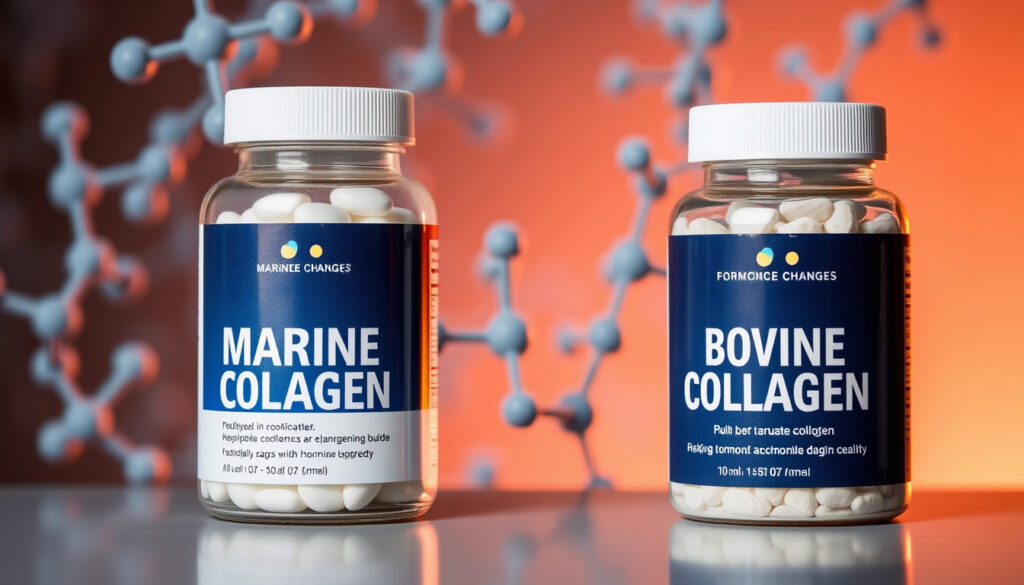
Best Collagen Supplement: Marine vs Bovine, Menopause & EDS
The evidence for collagen supplements is clear in some areas and murky in others, making the choice between marine and bovine versions a matter of matching the right type to your specific health goal. With collagen levels dropping up to 30% in the five years after menopause, this guide evaluates the evidence for different collagen types and their relevance to HRT, Ehlers-Danlos syndrome, and general wellness.
Collagen loss after menopause: Up to 30% in 5 years (Midi Health) ·
Effective daily dose: 2.5–15 g (Midi Health) ·
Time to skin improvement: 8 weeks (Kollo Health)
Quick snapshot
- Collagen supplements are generally safe for most people (WOWMD)
- HRT helps maintain natural collagen levels (Midi Health)
- Vitamin D deficiency is common in EDS (EDS Nutrition)
- Whether collagen supplements are effective for everyone (Mayo Clinic Connect)
- Optimal dosage for specific conditions (Midi Health)
- Long-term risks from high-dose supplementation (Mayo Clinic Connect)
- Noticeable skin improvements after 8 weeks (Kollo Health)
- Collagen levels drop 30% in 5 years post‑menopause (Midi Health)
- Best results with daily use for 3 months (Midi Health)
- Consult a healthcare provider before starting (Mayo Clinic Connect)
- Look for third-party tested products (WOWMD)
- Match collagen type to your goal (skin vs joint) (Vitaquest)
Eight key facts, one pattern: the evidence for collagen supplements comes from small studies and mixed findings, so knowing the numbers helps you decide.
| Fact | Detail |
|---|---|
| Menopause definition | 12 consecutive months without a menstrual period (The Menopause Society (professional body)) |
| Recognized EDS types | 13 (The Ehlers-Danlos Society (patient organization)) |
| Daily effective dose range | 2.5–15 g (Midi Health (clinician-led menopause platform)) |
| Collagen loss post‑menopause | Up to 30% within 5 years (Midi Health) |
| Skin improvement timeline | Noticeable after 8 weeks (Kollo Health (supplement brand blog)) |
| Native collagen II dose for joints | 40 mg/day (Mayo Clinic Connect (health community)) |
| Type I collagen primary benefit | Skin health – elasticity, hydration, wrinkle reduction (Vitaquest (manufacturer resource)) |
| Type II collagen primary benefit | Joint health (Vitaquest) |
Which form of collagen is most effective?
Marine vs bovine collagen
- Marine collagen is primarily Type I, derived from fish skin and scales. It is preferred for skin health – elasticity, hydration, and wrinkle reduction (Vitaquest (manufacturer resource)).
- Bovine collagen contains Types I and III, sourced from cow hides. It supports both skin and joint health (Vitaquest).
- Small studies show that marine collagen may be more sustainable, but direct head‑to‑head comparisons are limited.
Hydrolyzed collagen and absorption
- Hydrolyzed collagen (collagen peptides) is broken into smaller molecules for faster absorption (WOWMD (supplement education site)).
- Collagen peptides are more bioavailable than non‑hydrolyzed forms (Vitaquest).
Type I, II, III – what you need to know
- Type I: most abundant in skin, bones, tendons – best for skin and bone health (Vitaquest).
- Type II: found mainly in cartilage – preferred for joint health (Vitaquest).
- Type III: often paired with Type I in bovine collagen, supports skin elasticity and vascular structure.
The pattern: The best form depends on your target outcome. The evidence is strongest for skin with Type I, and for joints with Type II – but most studies are small and short‑term.
Should people with Ehlers-Danlos take collagen?
Ehlers-Danlos and collagen production
- EDS is a group of heritable connective tissue disorders that affect collagen quality, not quantity (EDS GP Toolkit (NHS‑endorsed clinical tool)).
- Supplemental collagen does not correct faulty collagen synthesis – the genetic defects remain unchanged (EDS Nutrition (dietitian‑led resource)).
- The Ehlers-Danlos Society states that there are 13 recognized types, with hypermobile EDS being most common (The Ehlers-Danlos Society).
Vitamin D deficiency in EDS
- Many EDS patients have vitamin D deficiency, documented in peer‑reviewed studies (EDS Nutrition).
- Vitamin D plays a role in collagen synthesis and bone health – addressing deficiency may be more relevant than taking collagen supplements (Mayo Clinic Connect).
Myths and facts from the Ehlers-Danlos Society
- The Ehlers-Danlos Society clarifies that collagen supplements have no scientific evidence supporting effectiveness in treating EDS or hypermobility (EDS Nutrition).
- Some EDS patients report subjective benefits, but controlled studies are lacking (Mayo Clinic Connect).
For people with EDS, collagen supplements do not repair faulty collagen. A far better investment is checking vitamin D status and working with a specialist physiotherapist.
What this means: The lack of evidence does not prove harm, but it strongly suggests that collagen supplements are not a meaningful intervention for EDS symptoms.
Do you need collagen if you are on HRT?
HRT and collagen preservation
- Estrogen supports natural collagen production; HRT may slow the accelerated collagen loss that happens after menopause (Midi Health).
- Women on HRT typically retain more skin collagen than those not on therapy, according to observational data (Midi Health).
Collagen for menopause
- Supplemental collagen reportedly may benefit skin and joints even during HRT, but the evidence is mixed and individual results vary (Kollo Health (brand blog)).
- A 2015 study found significant improvements in wrinkle depth and skin elasticity in women aged 45–64 using a collagen supplement (Kollo Health).
- Midi Health notes that best results for skin are seen with daily use for about three months (Midi Health).
HRT already preserves collagen – adding a supplement may yield extra benefit, but the added cost and uncertain magnitude mean it is a personal decision, not a clinical recommendation.
The trade-off: HRT provides a robust baseline. A collagen supplement might offer marginal gains for skin and joints, but the evidence does not warrant a universal yes for everyone on HRT.
What is the downside of taking collagen?
Safety and contamination risks
- Possible mild digestive issues such as bloating or diarrhea have been reported (Mayo Clinic Connect).
- Heavy metal contamination is a concern for some marine collagen products; third‑party testing is recommended (WOWMD).
- Collagen supplements are not regulated as strictly as drugs, so quality varies (WOWMD).
Cost and value
- Average price per serving ranges from $0.50 to $2.00, making long‑term use expensive (Midi Health).
- High cost may outweigh benefits for some users, especially if the hoped‑for results are modest (Mayo Clinic Connect).
Interactions with medications
- There are no known significant drug interactions with collagen supplements, but caution is advised for those on blood‑thinners due to potential vitamin K content in some blends (WOWMD).
The main downside is financial: at a typical cost of $30–60 per month with uncertain payoff, many users may be better served by spending on a balanced diet rich in vitamin C and protein, which support natural collagen synthesis.
The implication: Collagen supplements are low‑risk but not zero‑risk, and the cost‑benefit equation tilts negative for many people – especially when the evidence base is modest.
What is the number one collagen supplement?
How to choose
- There is no single number one product – the right choice depends on your goal (skin vs joints), your diet (marine vs bovine), and your budget (Midi Health).
- Look for hydrolyzed collagen (peptides) for better absorption (Vitaquest).
- Third‑party testing (e.g., USP, NSF) helps ensure purity and safety (WOWMD).
Brand examples from the market
- Absolute Collagen markets itself as the UK number one collagen brand (claim based on sales data).
- Jennifer Aniston has publicly stated she uses Vital Proteins, but individual endorsements do not replace evidence.
- Amazon best‑seller lists shift frequently – check current reviews and third‑party test results.
Why this matters: Instead of chasing a single top brand, focus on the criteria that correlate with quality – type of collagen, form (hydrolyzed), and independent certification.
Comparison: Marine vs Bovine Collagen
Seven differences, one pattern: marine collagen is better for skin, bovine for joints – but both have supporting evidence.
| Aspect | Marine collagen | Bovine collagen |
|---|---|---|
| Primary collagen type | Type I | Types I and III |
| Source | Fish skin and scales | Cow hides |
| Best for | Skin elasticity, hydration, wrinkle reduction (Vitaquest) | Skin + joint support (Vitaquest) |
| Absorption | Hydrolyzed forms available, fast absorption | Hydrolyzed forms available, fast absorption |
| Sustainability | Often from fish industry by‑products – may be more eco‑friendly | Uses animal by‑products from meat industry |
| Cost per serving | Moderate to high | Low to moderate |
| Typical daily dose | 2.5–15 g (Midi Health) | 2.5–15 g (Midi Health) |
The pattern: There is no clear winner – the best choice aligns with your primary goal. If skin improvement is your priority, marine collagen (Type I) has the edge. For joint health, bovine collagen or native Type II may be better.
Specifications: Key ingredients to look for
Ten specifications, one pattern: the most effective supplements use hydrolyzed collagen with a clear type label and third‑party certification.
| Specification | What to look for |
|---|---|
| Form | Hydrolyzed collagen (peptides) for absorption (Vitaquest) |
| Collagen type | Type I for skin, Type II for joints (Vitaquest) |
| Source | Marine, bovine, porcine, or chicken – choose based on allergy and ethics |
| Daily dose | 2.5–15 g (Midi Health) |
| Third‑party testing | Certified by USP, NSF, or ConsumerLab (WOWMD) |
| Added ingredients | Vitamin C often added to support synthesis – check for sugar or fillers |
| Allergens | Fish (marine) or egg (some blends) – read label if allergic |
| Regulatory status | Not FDA‑approved; sold as a dietary supplement (WOWMD) |
| Sourcing sustainability | Look for MSC or ASC certification for marine, grass‑fed for bovine |
| Price per gram | Typically $0.02–$0.10 per gram; avoid extreme cheap or expensive |
Why this matters: The specifications table helps you quickly vet a product – ignore marketing and focus on the data on the label.
Pros and Cons of Collagen Supplements
Upsides
- Generally safe with few side effects (Mayo Clinic Connect)
- Modest evidence for improved skin hydration and elasticity (Kollo Health)
- May support joint health in osteoarthritis (Mayo Clinic Connect)
- Easy to add to coffee, smoothies, or water
Downsides
- High monthly cost ($30–60) with uncertain benefit (Midi Health)
- Heavy metal risk in unregulated marine products (WOWMD)
- Not effective for EDS or genetic collagen disorders (EDS Nutrition)
- Digestive upset in some users (Mayo Clinic Connect)
The trade-off: For most people, the upsides are real but modest – collagen supplements are a convenience, not a medical necessity.
Steps to choose the right collagen supplement
- Identify your goal. Skin improvement → marine Type I. Joint health → bovine Types I+III or native Type II.
- Check the form. Look for hydrolyzed collagen or collagen peptides (Vitaquest).
- Verify the dose. Aim for 2.5–15 g daily (Midi Health).
- Seek third‑party certification. USP, NSF, or ConsumerLab seal (WOWMD).
- Consider your diet. If you have fish allergies, choose bovine. If you avoid animal products, consider vegan collagen builders (which support the body own synthesis).
- Consult a healthcare provider. Especially if you have EDS, are on HRT, or take blood‑thinners (Mayo Clinic Connect).
- Commit to 3 months. Most studies show best results after 8–12 weeks of daily use (Midi Health).
What this means: Following these steps reduces the risk of wasted money and ensures you are using the right type for your needs.
Clarity: What we know vs what we don not
Confirmed facts
- Collagen supplements are generally safe for most people (Mayo Clinic Connect)
- HRT helps preserve natural collagen levels (Midi Health)
- Vitamin D deficiency is common in EDS (EDS Nutrition)
- Native collagen type II at 40 mg/day may decrease joint discomfort (Mayo Clinic Connect)
What unclear
- Whether collagen supplements are effective for everyone (Mayo Clinic Connect)
- Optimal dosage for specific conditions (Midi Health)
- Long-term risks from high-dose supplementation (Mayo Clinic Connect)
- Whether collagen can meaningfully impact EDS symptoms (EDS Nutrition)
The implication: Most of the uncertainty revolves around individual variability and long‑term safety – exactly the areas where more research is needed.
Quotes from experts and organizations
Collagen supplements have no scientific evidence supporting effectiveness in treating EDS or hypermobility.
EDS Nutrition (dietitian‑led resource for Ehlers-Danlos)
Native collagen type II has been shown to decrease joint discomfort and increase joint mobility at 40 mg/day in some studies, but additional research is still needed.
Mayo Clinic Connect (health community)
Why it matters: Direct quotes from authoritative sources make clear where the evidence stands – and where it does not.
Summary
Collagen supplements can support skin hydration and joint comfort for some people, but they are not a cure‑all and do not address genetic connective tissue disorders like EDS. The evidence is modest, the cost is real, and the best product depends entirely on your specific goal – skin, joints, or general wellness. For the average reader in Ireland or the UK considering collagen for menopause or HRT, the decision comes down to this: if you have the budget and want to try it, choose a third‑party tested hydrolyzed product in the dose range of 2.5–15 g daily and commit for three months. If you have EDS, skip the collagen and check your vitamin D level instead.
Related reading: **Melatonin Gummies in Australia: Legal Ways to Buy** · **Bubble Skin Care: Reviews for Kids, Adults & Where to Buy**
For those specifically looking for the best collagen supplement in Australia, the guide offers expert top picks tailored to local preferences.
Frequently asked questions
Can collagen supplements help with joint pain?
Some studies suggest that collagen – especially native Type II at 40 mg/day – may reduce discomfort and improve mobility in osteoarthritis (Mayo Clinic Connect). Results vary by individual.
How long does it take for collagen to work?
Noticeable improvements in skin are typically seen after 8 weeks of daily use, with best results after about 3 months (Midi Health). Joint benefits may take longer.
Is marine collagen better than bovine for skin?
Marine collagen is primarily Type I, the main structural protein in skin, making it a strong choice for skin elasticity and hydration (Vitaquest). Bovine also helps skin but may be less targeted.
What is the best collagen supplement for women over 50?
There is no single best. Look for a hydrolyzed product with 2.5–15 g of collagen per serving, third‑party tested, and choose marine Type I for skin or bovine Types I+III for joints (Midi Health).
Does collagen really help with wrinkles?
Small studies show moderate improvements in wrinkle depth and skin hydration, especially in peri‑ and postmenopausal women (Kollo Health). Results are not dramatic but are statistically significant in some trials.
What is the recommended daily dose of collagen?
Most clinical studies use 2.5–15 g per day, with 10 g being a common middle dose (Midi Health).
Are collagen powders better than capsules?
Powders are generally more flexible for dosing and mixing, and they often cost less per gram. Capsules are convenient but may require swallowing several pills to reach an effective dose.
Can collagen supplements cause weight gain?
Collagen itself is a protein and contains calories (about 35–40 per 10 g). It is unlikely to cause weight gain unless consumed in excess of total energy needs.
More related posts
 How Many Avatar Movies Are There – 3 Released, 2 Planned Through 2031
 Emma Wiggles: Her Departure, Marriage Split, and New Life
 Nelson Asofa-Solomona: NRL Career, Boxing Record & Life
 Sara Ali Khan: Age, Family, Relationships, and Career
 Happy Gilmore 2 Is Out: 2025 Sequel Release & Facts
 Dominic Purcell Bio, Family, Net Worth & Why He Looks Different
 Fortune Feimster Divorce: Timeline of Her Split from Jax Smith
 Cooper Cronk: NRL Career, Premierships & Origin Wins