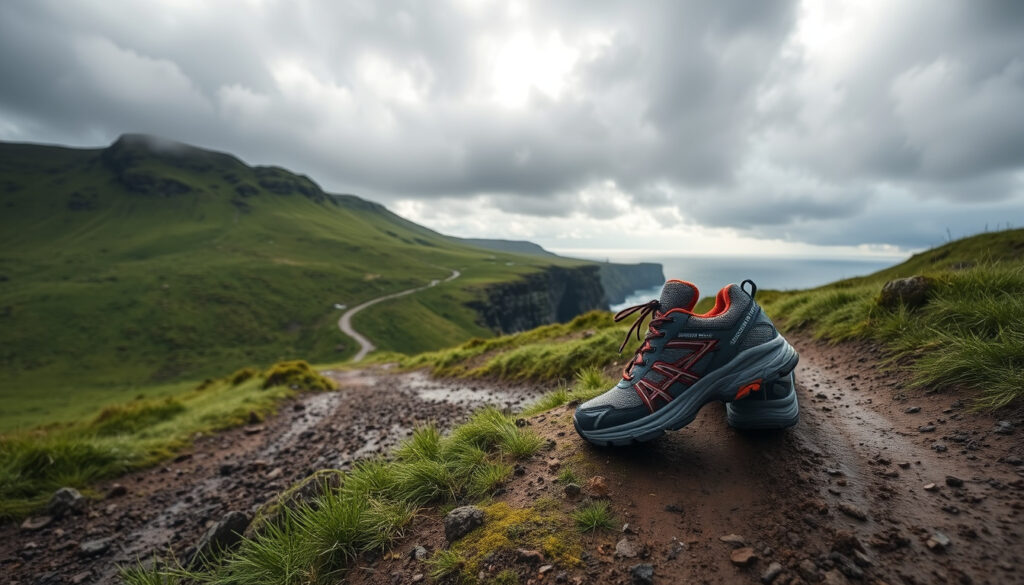
Best Trail Running Shoes: Buyer’s Guide for Irish Trails
If you’ve ever slipped on a wet rock in Wicklow or sunk knee-deep into bog on the Mournes, you already know the trail is no place for road shoes. Trail running shoes handle what pavement gear cannot — and the difference in grip, protection, and confidence is immediate once you’re on rough ground. This guide covers what sets them apart, how to pick the right pair for Irish conditions, and which models performed best in 2025 and 2026 testing.
Best overall: Adidas Terrex Agravic Speed Ultra · Top UK guide source: Runner’s World · Tested picks count: 7 in lab and trails · Popular brands: HOKA, Salomon, Adidas · Ireland retailers: New Balance IE, Elverys
Quick snapshot
- Adidas Terrex Agravic Speed Ultra is the best trail super shoe per RunRepeat lab testing
- Whether trail shoes reduce knee pain more than neutral road shoes — evidence is mixed and gait-dependent
- iRunFar and REI published 2026 rankings; Believe in the Run posted 2025 awards in late December
- Salomon, HOKA, and Saucony all have 2026 refreshes in the pipeline; the Pegasus Trail series is expected to expand road-to-trail options
| Fact | Detail |
|---|---|
| Primary use | Off-road trails |
| Key feature | Lugged outsoles |
| Top test site | RunRepeat |
| Popular in | Ireland retailers |
What are trail running shoes?
Trail running shoes are built for off-road terrain. Unlike road running shoes, they have aggressive, multi-directional lugs on the outsole that bite into mud, loose gravel, and wet grass — the kind of surfaces that send road shoes skidding sideways. They also carry reinforced toe caps, rock plates embedded in the midsole, and protective overlays that road shoes typically skip.
Key features of trail running shoes
A reinforced toe bumper shields your foot when you kick a root or stumble on a rock stair. The midsole uses firmer cushioning tuned for uneven ground rather than the soft foam engineered for smooth asphalt. Most trail shoes carry a 4–10mm heel-to-toe drop that keeps you forward on steep descents, and the outsole wraps higher around the shoe’s edge for grip on side slopes.
Trail vs road running shoes
The outsole is the clearest distinction: trail shoes have multi-directional lugs, while road shoes use flat rubber with shallow tread. Trail shoes also carry a rock plate and reinforced upper; road shoes prioritise breathability and heel cushioning. The 4–10mm drop on most trail shoes promotes a forward posture on downhills, whereas road shoes typically sit closer to neutral.
Aggressive lugs work brilliantly on soft ground but feel stiff and draggy on pavement. Shoes like the Salomon Speedcross 6 (10mm drop, 8.7/10 per iRunFar testing) are overkill for anything that isn’t genuinely muddy — which is exactly why they matter for a wet Irish autumn trail.
How to choose trail running shoes?
Terrain type is the single most important factor in choosing a trail shoe. Muddy, boggy ground calls for deep multi-directional lugs. Rocky mountain trails need a rock plate and decent stack height. Smooth forest paths let you get away with moderate lugs and a lighter shoe.
Factors like cushioning and fit
Stack height (the amount of foam under your foot) and heel-to-toe drop work together. Higher stack means more cushioning for long runs but less ground feel. Lower drop keeps you leaning forward on descents, which most trail runners prefer. For 30–60 minute runs on typical trails, a 4–5mm drop hits a good balance. If you’ve already transitioned to zero-drop, the Altra Lone Peak 9 remains a solid option at 0mm drop (verified by iRunFar, 9.0/10 score).
Terrain-specific needs
Irish trails throw wet, boggy ground and exposed rock at you in the same run. A shoe with 5–6mm multi-directional lugs handles both the mud and the stone, which is why the Saucony Peregrine 15’s 5.6mm lugs and 30mm stack height (Outdoor Gear Lab) come up repeatedly for this kind of terrain. For soft, waterlogged ground, nothing beats the Inov8 TrailTalon — iRunFar rates it 8.8/10 specifically for mud conditions.
The Saucony Peregrine 15 and Hoka Torrent 4 share something important beyond price: both are consistently stable across hundreds of trail miles. Outdoor Gear Lab testers report the Peregrine 15 works for beginners and experienced runners alike, which makes it a practical first trail shoe for someone converting from road running.
What are the best trail running shoes?
The honest answer depends entirely on what you need — but across iRunFar, Runner’s World, REI, RunRepeat, and Outside Online, a handful of models keep appearing at the top of their respective categories.
iRunFar’s 2026 rankings place the Hoka Speedgoat 7 at the top with a 9.6/10 score, calling it “comfy for long distances on any trail.” Runner’s World names the Salomon Pulsar Trail best overall for its around-$140 entry point, while the Saucony Peregrine 16 wins best for technical trails at 9.2/10. REI puts the New Balance Fresh Foam X Hierro V9 at the top of its round-robin tests, with Brooks Cascadia 19 and Topo Athletic Ultraventure 4 close behind. RunRepeat’s lab testing highlights the HOKA Tecton X 3 for energy return and the Adidas Terrex Agravic Speed Ultra as the best trail super shoe.
Four publications, six models, and not one of them names the same shoe best overall — which tells you that the right choice depends entirely on your terrain, your foot, and your pace.
Across the comparison group, scores cluster tightly between 8.3 and 9.6/10, with prices ranging from $145 to $195 for the majority of models tested.
| Model | Score | Weight (oz) | Price (USD) | Drop (mm) |
|---|---|---|---|---|
| Hoka Speedgoat 7 | 9.6/10 | 9.1 | $165 | — |
| Saucony Peregrine 16 | 9.2/10 | 9.5 | $150 | 4 |
| Brooks Cascadia 19 | 9.0/10 | 10.7 | $150 | 6 |
| Altra Lone Peak 9 | 9.0/10 | 10.3 | $145 | 0 |
| Nike Pegasus Trail 5 | 8.5/10 | 10.2 | $155 | 9.5 |
| Inov8 TrailTalon | 8.8/10 | 9.7 | $150 | 6 |
| Salomon Speedcross 6 | 8.7/10 | 10.4 | $150 | 10 |
| La Sportiva Akasha II | 8.9/10 | 11.5 | $195 | 6 |
| Topo Ultraventure 4 | 8.3/10 | 10.1 | $155 | 5 |
Eight models earn scores between 8.3 and 9.6/10 across iRunFar’s 2026 testing, with price clustering tightly around $145–$165 — the Speedgoat 7’s $165 tag buys meaningfully higher marks, while the Lone Peak 9 and Topo Ultraventure 4 undercut the field without dropping into budget territory.
The data shows a clear tier: Hoka dominates the top score, but mid-range options like Brooks and Altra deliver 90% of the performance at 90% of the price.
| Model | Stack height (mm) | Heel drop (mm) | Notes |
|---|---|---|---|
| Saucony Peregrine 15 | 30 | 4 | 5.6mm lugs — versatile for mud and rock |
| Hoka Speedgoat 7 | — | — | Highest marks for long-distance comfort |
| Brooks Cascadia 19 | — | 6 | Best all-around; reliable across conditions |
| Altra Lone Peak 9 | — | 0 | Zero-drop for natural running form |
| Nike Pegasus Trail 5 | — | 9.5 | Road-to-trail hybrid; moderate lugs |
| Inov8 TrailTalon | — | 6 | Best for muddy, soft Irish trails |
| Salomon Speedcross 6 | — | 10 | Deep lugs; specialist soft-ground tool |
| Hoka Tecton X 3 | — | 5 | Best energy return per RunRepeat lab tests |
| La Sportiva Akasha II | — | 6 | High stack for ultra distance comfort |
| Topo Ultraventure 4 | — | 5 | Budget-friendly with solid all-round performance |
The Peregrine 15 sits in the sweet spot for Irish terrain: a 30mm stack cushions rocky paths, 4mm drop keeps you forward on descents, and 5.6mm lugs grip wet ground without packing full of mud.
Upsides
- Multi-directional lugs grip wet, muddy ground where road shoes slip — essential for Ireland’s boggy trails
- Reinforced toe caps and rock plates protect feet on rocky Wicklow and Mourne paths
- Strong selection from $145 to $275 across brands; no premium tier monopolises the top scores
- Zero-drop options (Altra Lone Peak 9) and maximalist cushioning (Speedgoat 7) both score 9.0+
Downsides
- Aggressive lugs feel stiff and draggy on road — a dedicated trail shoe is a poor everyday trainer
- Ultra-cushioned models like the Speedgoat 7 may increase knee joint loading for some runners
- Limited road-to-trail versatility: only hybrid models like Pegasus Trail 5 cross over comfortably
- Irish availability is uneven — some top-rated models require ordering from specific retailers
Can you run normally in trail running shoes?
You can run on pavement in trail shoes — but the trade-offs are real. Deep lugs create drag on smooth surfaces, the heavier construction tires your legs faster over time, and the stiff midsole designed for rock protection works against the natural stride mechanics that road shoes support.
Road use pros and cons
The Nike Pegasus Trail 5 is the clearest exception: Runner’s World lists it as best road-to-trail option, and iRunFar rates it 8.5/10 with a 9.5mm drop for men — the highest drop in our comparison group, which actually makes it closer to a road shoe than a trail specialist. If your routes mix urban footpaths with canal paths and trail loops, a hybrid like this saves you owning two pairs.
Versatility limits
Beyond the Pegasus Trail 5, most trail shoes penalise you on pavement. The Salomon Speedcross 6’s 10mm drop and deep lugs feel planted and sluggish on the road — which is exactly right for soft ground and completely wrong for a 5K on tarmac. The Altra Experience Wild 3 (Runner’s World pick for mixed surfaces) is a better option if your mix skews 50/50 between trail and road.
Buying a trail shoe as your only running shoe because it seems more “technical” means you’ll spend more energy on every road leg of your run. For most Irish runners logging 20–30km per week across mixed terrain, the Pegasus Trail 5 or Altra Experience Wild 3 is the smarter call — a dedicated trail shoe is worth it only if 80% of your mileage is off-road.
Are trail running shoes good for knee pain?
This is where the evidence gets genuinely murky. Trail shoes don’t automatically protect knees better than road shoes — the relationship between cushioning, joint load, and injury varies too much between individuals for any blanket claim.
Cushioning impact
Higher stack height absorbs shock on hard landings, which should reduce joint load on paper. The Hoka Speedgoat 7’s thick midsole is a case in point: iRunFar rates it best for long distances, and the maximalist cushioning concept behind HOKA is built around this idea. But some biomechanics research suggests that extremely soft cushioning can actually increase knee loading by changing stride mechanics — so more cushion doesn’t guarantee less stress.
HOKA experiences
Many runners report that HOKA’s pronounced heel beveling and rocker geometry change the strike pattern in ways that feel great initially but aggravate knees over time, especially if you’re used to a flatter drop. If you’ve had knee pain in HOKA models before, the lower-drop Brooks Cascadia 19 (6mm drop, 9.0/10) or Saucony Peregrine 16 (4mm drop, 9.2/10) may be worth trying first.
How to choose the right pair
Choosing the right trail shoe comes down to four practical steps — terrain, stack and drop, fit, and budget — before you ever look at a score or a price tag.
- Match the lug to the ground. For Ireland’s wet, boggy trails, look for 5–6mm multi-directional lugs. The Inov8 TrailTalon (8.8/10 for mud, $150) and Salomon Speedcross 6 (8.7/10, $150) are designed for exactly this. If your usual routes are dry and rocky, 3–4mm lugs and a rock plate matter more.
- Pick your stack and drop based on your current shoe. If you’re coming from a neutral road shoe, a 4–5mm drop is a manageable transition. Zero-drop trail shoes like the Altra Lone Peak 9 ($145) work well for runners already adapted to that feel — but they’re a poor first step if you’ve never run in zero-drop.
- Test the fit in person where possible. Salomon’s Quicklace system with the lace pocket (Speedcross 6) keeps laces away from brambles and heather on Irish hills — a small detail that becomes very real on a long trail run.
- Buy from Irish retailers where you can. New Balance IE and Elverys stock common trail models, which matters for exchanges and returns. For models not stocked locally, iRunFar and RunRepeat provide detailed specs so you can verify fit and drop before ordering from abroad.
Confirmed
- Adidas Terrex Agravic Speed Ultra ranked best trail super shoe in RunRepeat lab testing (2025/2026)
- Hoka Speedgoat 7 tops iRunFar’s 2026 rankings at 9.6/10 with $165 price and 9.1 oz weight
- Salomon Pulsar Trail wins Runner’s World best overall at around $140 — strong value for Irish buyers
Unclear
- Whether trail shoes reduce knee pain more than neutral road shoes — the biomechanics vary by individual gait and cushioning preference
- Which 2026 models will arrive in Irish retail channels and at what EUR price points
- Whether HOKA’s maximalist cushioning increases or decreases knee joint load for heel-strikers — evidence is conflicting
iRunFar Editors (Review Team): “Overall, the Hoka Speedgoat 7 is a comfy shoe that can go the distance on any trail.”
Runner’s World (Gear Editors): “Salomon Pulsar Trail is a win for us for so many reasons, but the entry point of about $140 is hard to beat.”
For Irish trail runners, the choice comes down to one practical reality: most weeks your runs involve a mix of wet grass, rocky paths, and exposed ground that punishes road shoes immediately. A shoe with 5–6mm multi-directional lugs — the Inov8 TrailTalon for mud or the Saucony Peregrine 15 for technical mixed terrain — changes the texture of every run from the first step. The Hoka Speedgoat 7 and Salomon Pulsar Trail remain the two safest top picks across the most testing sources, with the Cascadia 19 as the consistent backup for anyone who wants a reliable all-rounder at $150.
Related reading: New Balance Rebel v5 – Specs Performance v4 Comparison · Garmin Instinct 2 – Specs Battery Life Comparisons 2024
Frequently asked questions
Is trail running good for glutes?
Yes — the uneven terrain activates gluteus maximus and medius more than flat-surface running because your hips and core work harder to stabilise each landing on angled ground. Trail running consistently surfaces in biomechanics studies as a more effective glute activator than equivalent-pace road running.
What is the 80/20 rule for trail running?
The 80/20 rule (polarised training) means roughly 80% of your weekly mileage at low intensity and 20% at high intensity. Applied to trail running, this typically means easy trail loops at conversational pace and a shorter session of hill repeats or technical sprints — the trail terrain naturally adds intensity variation that road running lacks.
Is running 5K bad for the knees?
Running 5K three or four times a week is not inherently bad for healthy knees — the bigger factors are load management, running surface, and shoe selection. Soft trails reduce joint loading compared to hard pavement, which is one reason trail running is often better tolerated by runners with existing knee niggles than road-only programmes.
Does running help a saggy bum?
Running builds glute and hamstring endurance over time, but spot reduction doesn’t happen — you lose body fat across the whole body, not selectively. Trail running adds uphill work that particularly loads the glutes, which makes it more effective than flat road running for lower-body toning at equivalent effort.
Will running 3 times a week tone me up?
Three runs per week is a solid starting point for visible tone improvements in legs, glutes, and core within 6–10 weeks for most beginners — particularly if the routes include hills or varied terrain. Consistency matters more than volume, and adding two strength sessions per week accelerates results significantly.
What running shoes are good for knee pain?
There is no universal answer — the best shoe for knee pain depends on your gait, strike pattern, and existing injury history. Brooks Cascadia 19 (6mm drop, 9.0/10) and Saucony Peregrine 16 (4mm drop, 9.2/10) are consistently well-reviewed for stability and moderate cushioning that suits many runners with knee concerns. If you suspect overloading from maximalist cushioning, stepping down to a mid-drop, firmer-midsole model often helps.
Why do Hokas hurt my knees?
HOKA’s pronounced rocker geometry and tall heel can shift the strike point backward in some runners, increasing knee extension torque at initial contact. Runners accustomed to a flatter, midfoot strike may find HOKA’s beveled heel changes their mechanics enough to aggravate knees even though the shoe feels soft underfoot. If HOKA hurts, try a lower-drop model like the Peregrine 16 or Cascadia 19 before concluding that trail shoes are the problem.
More related posts
 My Gov Account – Create Login Manage Troubleshoot
 Gabrielle Union: Health, Marriage, Net Worth, and Biography
 Chemist Warehouse Maryborough – Location, Hours and Contact
 Will Smith: Oscars Slap, Marriage, Health, and Comeback
 Theo James: Wife, Children, Height, and the Truth Behind the Rumors
 The Crew Motorfest 2025: Active, vs Forza Horizon & Crew 2
 Role Models (2008) Movie – Is It Good? Age Rating & Parent Guide
 Aged Pension Australia: Rates, Eligibility & Calculator 2026