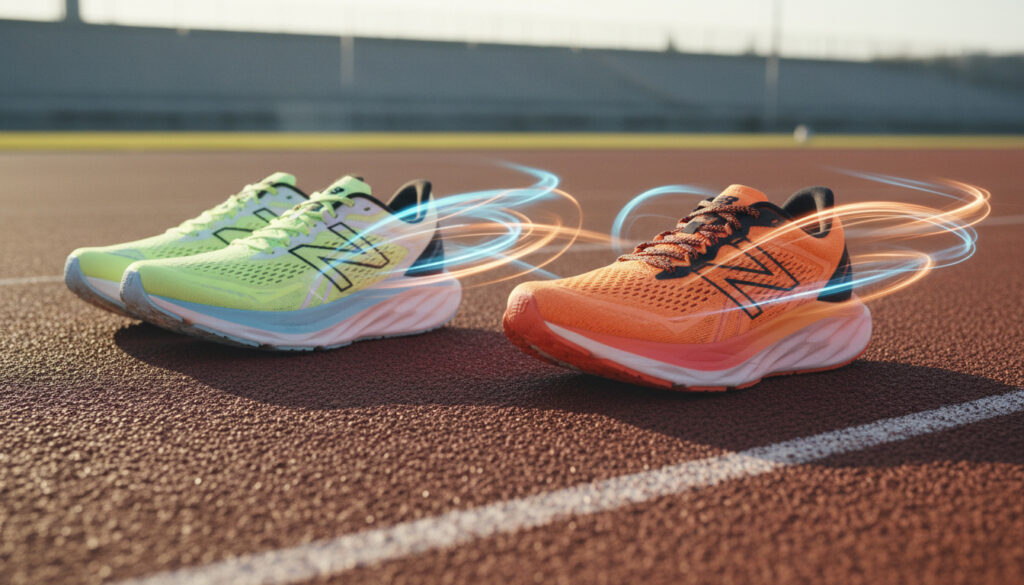
New Balance Rebel v5 – Specs Performance v4 Comparison
The New Balance FuelCell Rebel v5 arrives as a calculated departure from its predecessor’s ethos, trading the v4’s razor-sharp speed sensitivity for a more accommodating, high-mileage demeanor. At its core sits a retooled FuelCell midsole—now a softer PEBA/EVA blend containing 20 percent PEBA—delivering a cushioned ride that prioritizes elasticity and stability over aggressive ground feedback. Without a carbon fiber plate, the shoe relies entirely on foam geometry and density to propel runners through daily training, long runs, and recovery sessions rather than podium-focused racing.
Launched as the successor to the early-2024 Rebel v4, the v5 increments stack height by approximately five millimeters and adds roughly 20 to 25 grams of weight, modifications that shift its classification from a dedicated speed trainer toward a versatile daily workhorse. The upper exchanges the v4’s minimal FantomFit mesh for a more structured engineered mesh with enhanced heel and midfoot lockdown, while the outsole transitions from partial rubber coverage to a full NDurance rubber layout aimed at solving durability complaints that plagued the previous version.
What Are the Key Specs of the New Balance FuelCell Rebel v5?
| Weight 7.9–8.3 oz (225g men’s US 9) |
Drop 6mm (heel-to-toe offset) |
Stack Height 35mm heel / 29mm forefoot |
Price Range ~$139.95 (USD retail) |
- Softer, more elastic FuelCell foam tuned for 30-kilometer-plus runs compared to the firmer v4
- Full NDurance rubber outsole addresses previous durability limitations with projected 500–700 kilometer lifespan
- Engineered mesh upper with padded tongue improves lockdown while maintaining breathability
- Available in standard and wide widths to accommodate broader foot shapes
- No carbon plate design differentiates it from super shoes like the Nike Vaporfly
- Approximately 20–25 grams heavier than the v4 due to increased foam volume
- True-to-size fit with a more secure midfoot wrap than the spacious v4
| Feature | Rebel v5 Specification | Comparison to Rebel v4 |
|---|---|---|
| Weight | 7.9–8.3 oz (225g men’s US 9) | 7.4–7.9 oz (~219g); v5 is heavier |
| Heel Stack | 35mm | 30–34mm; v5 adds ~5mm |
| Forefoot Stack | 29mm | 24–28mm; v5 adds ~5mm |
| Drop | 6mm | 6mm (unchanged) |
| Midsole Composition | Softer PEBA/EVA blend (20% PEBA) | Firmer PEBA/EVA; snappier response |
| Outsole Coverage | Full NDurance rubber | Partial rubber with exposed foam |
| Upper Construction | Structured engineered mesh, padded tongue | Lightweight FantomFit, minimal padding |
| Carbon Plate | None | None |
How Does the Rebel v5 Compare to the v4 and Other Shoes?
Direct comparisons reveal a fundamental philosophical shift between generations. Testing by Running Shoes Guru indicates the v5’s higher stack and softer foam create a plusher, more relaxed ride that absorbs impact over marathon distances, whereas the v4’s lower, firmer platform delivered superior ground proprioception and agility for interval sessions.
Rebel v5 versus Rebel v4
The v5’s additional five millimeters of stack height, confirmed by RTINGS laboratory measurements, fundamentally alters the shoe’s center of gravity. While the v4 maintained a nimble, “fast-day” personality with a wider base and firmer midsole, the v5 introduces a subtle lean bias due to its elevated cushion. The outsole upgrade represents the most tangible durability improvement, replacing the v4’s sparse rubber placement with comprehensive NDurance coverage that testers estimate will withstand 500 to 700 kilometers of road use.
Comparison to Plated Racers
Unlike the Nike Vaporfly or Streakfly, the Rebel v5 operates without a carbon fiber plate, placing it in a distinct category of non-plated performance trainers. Video analysis confirms the shoe depends on foam rebound alone, resulting in a less aggressive toe-off that favors relaxed efficiency over racing intensity. This architecture makes the v5 unsuitable for runners seeking maximal energy return during 5K or 10K racing, but ideal for athletes who want super shoe aesthetics without the rigid propulsion of a plate.
The v5’s engineered mesh upper runs narrower than the v4’s accommodating FantomFit construction. Runners with broad forefeet should consider the wide-width option or try the shoe in-store before purchasing.
Is the New Balance Rebel v5 Good for Racing and Training?
Daily Training and Long Runs
The Rebel v5 excels as a daily trainer for aerobic base building and extended efforts. Reviews from ADS Running highlight the foam’s elasticity during tempo runs and its ability to maintain comfort beyond 30 kilometers, a distance that exposed the v4’s cushioning limitations. The padded tongue and structured heel counter reduce irritation during high-mileage weeks, while the full rubber outsole provides consistent traction on wet pavement.
Speedwork and Racing Limitations
Despite its lightweight classification, the v5 sacrifices the snappy responsiveness required for track intervals or short road races. Comparative testing demonstrates that the higher stack dampens ground feel, reducing the agility necessary for sharp cornering or pace changes. Runners seeking a shoe for 5K racing or VO2max sessions will find the v4 or dedicated plated racers more appropriate.
Performance Trade-offs
Advantages: The softer FuelCell compound delivers smooth transitions and reduced joint stress, while the durable outsole extends the shoe’s economic viability for high-volume runners. The stable platform accommodates moderate pronation without correction devices.
Limitations: The weight increase and higher stack reduce the “disappearing” sensation sought in race-day footwear. The narrower toe box may cause discomfort for runners with high-volume feet, and the absence of a plate limits top-end speed potential compared to super shoes.
New Balance Rebel v5 Pricing, Sizing, and Buying Guide
Retail Price and Availability
The Rebel v5 maintains the v4’s retail positioning at approximately $139.95, placing it in the mid-range category for performance trainers. Doctors of Running note that while the v4 remains available through select retailers, the v5 represents New Balance’s current flagship non-plated option. Buyers seeking value might consider the v4 for pure speedwork, though its inferior outsole durability may offset initial savings.
Sizing and Fit Guidance
The shoe fits true to size for most runners, though the transition from the v4’s spacious last to the v5’s structured midfoot requires attention. Those who relied on the v4’s wide toe box may need to select the wide-width variant of the v5 to achieve equivalent comfort. Aldi Toilet Paper – 2025 Brands Prices Quality Guide recommends verifying fit during afternoon runs when feet swell to natural training dimensions.
With full NDurance rubber coverage, the v5 outlasts the v4 significantly. Runners reporting 500 to 700 kilometers per pair confirm the update resolves the premature wear issues that limited the previous model’s lifespan.
The v5’s engineered mesh offers less vertical stretch than the v4’s FantomFit material. High-volume insteps may experience pressure across the dorsal surface during initial wear.
How Has the New Balance Rebel Series Evolved?
- Early 2024: New Balance releases the Rebel v4, characterized by a firmer FuelCell midsole, minimal rubber outsole, and a lightweight FantomFit upper designed for speed-oriented training. Medical review confirms its classification as a responsive, low-profile trainer.
- Mid-2024: User feedback and wear testing reveal durability concerns regarding the v4’s exposed foam outsole, prompting design revisions for the successor model. Aggregate data indicates below-average outsole longevity compared to category competitors.
- Late 2024/2025: The Rebel v5 debuts with a softer PEBA/EVA blend, five millimeters of additional stack height, and a full-coverage NDurance rubber outsole. Technical breakdowns document the shift from speed-focused geometry to high-mileage comfort.
What Do Lab Tests Confirm About the Rebel v5?
| Established Specifications | Uncertainties and Variables |
|---|---|
| 35mm heel stack / 29mm forefoot (6mm drop) verified by multiple sources | Exact release date remains unspecified beyond “2024/2025” window |
| Weight ranges between 7.9–8.3 oz for men’s US 9 | Precise weight varies by production batch and size |
| FuelCell foam contains 20% PEBA blended with EVA | Long-term compression set after 700+ kilometers unverified |
| Full NDurance rubber outsole replaces v4’s partial coverage | Subjective fit narrowness depends on individual foot morphology |
| No carbon plate present in midsole architecture | Optimal mileage lifespan estimates (500–700km) based on projections |
How Does the Rebel v5 Position Itself in the Market?
The Rebel v5 occupies a narrowing niche between minimal racing flats and maximal super shoes, offering the protective cushioning of the latter without the propulsive hardware. This positioning targets runners who train in plated racers but require a recovery-day option that mimics stack height without the rigidity. AGL Internet Plans – 2025 Prices Speeds Bundles Reviewed draws parallels to selecting reliable infrastructure—investing in consistent daily training tools often yields better results than sporadic use of high-performance gear.
Market analysis suggests the v5 competes directly with other non-plated daily trainers like the Nike Pegasus or Brooks Hyperion, though its FuelCell foam provides a distinct underfoot sensation compared to traditional EVA or TPU compounds. The shoe’s $140 price point undercuts most carbon-plated alternatives by nearly 40 percent, making it an economically rational choice for runners building weekly volume.
What Do Expert Testers Report?
“The Rebel v5 represents an evolution toward broader appeal, sacrificing the v4’s raw speed for versatility that accommodates easy runs and long efforts without the harshness of a dedicated race shoe.”
— Running Shoes Guru
“While the higher stack introduces a slight lean bias, the improved outsole durability and upper comfort make this a legitimate daily trainer for high-mileage athletes.”
— RTINGS Laboratory Analysis
Final Verdict: Who Should Buy the Rebel v5?
The New Balance FuelCell Rebel v5 serves runners prioritizing cushioned daily miles and long-run protection over racing-day aggression, particularly those who found the v4 too firm or short-lived. Athletes requiring a carbon plate for speedwork or possessing very wide feet should explore alternatives, but for high-volume training at moderate paces, the v5’s durable outsole and elastic foam present a compelling value proposition at its $140 price point.
Common Questions About the Rebel v5
What is the New Balance FuelCell Rebel v5?
The Rebel v5 is a lightweight daily training shoe featuring FuelCell foam with a PEBA/EVA blend, offering a softer, more cushioned ride than its predecessor without a carbon plate.
Does the New Balance Rebel v5 contain a carbon fiber plate?
No, the Rebel v5 does not contain a carbon fiber plate. It relies entirely on its FuelCell foam midsole for energy return and propulsion.
Who is the ideal runner for the Rebel v5?
The Rebel v5 suits runners seeking a versatile daily trainer for easy runs, long distances, and tempos, particularly those prioritizing cushioning over racing agility.
How does the Rebel v5 perform in wet conditions?
The full NDurance rubber outsole provides reliable traction on wet roads, addressing previous durability concerns with comprehensive coverage.
Can the Rebel v5 handle high weekly mileage?
Yes, the Rebel v5 is designed for high mileage with a projected lifespan of 500–700 kilometers, making it suitable for consistent daily training.
What is the expected lifespan of the Rebel v5 outsole?
The NDurance rubber outsole offers significantly improved durability compared to the v4, with estimates suggesting 500–700 kilometers of use.
More related posts
 Lee Sung-Kyung: Biography, Relationships, Height, and Facts
 Jai Newcombe: From Undrafted to Hawthorn Co-Captain
 Homemade Beef Chow Mein: 25 Minute Recipe Like Takeout
 Bubble Skin Care: Reviews for Kids, Adults & Where to Buy
 Dogs for Sale in Ireland: Trusted Listings & Buyer’s Guide
 My Gov Account – Create Login Manage Troubleshoot
 Le Creuset Sale – Current Deals, Outlets and Discounts Guide
 Hayley Atwell: Biography, Family, Career & Tom Cruise Rumors