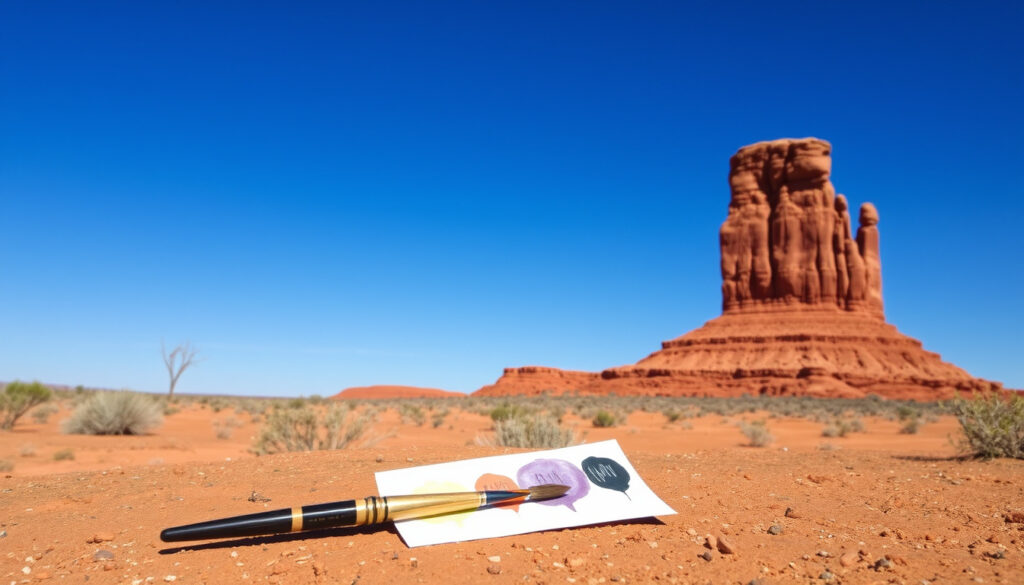
Albert Namatjira: First Aboriginal Citizen, Master Watercolourist
Few lives capture the contradictions of mid‑20th‑century Australia quite like Albert Namatjira’s. A celebrated watercolourist who put the red heart of the continent on the world map, he was also the first Aboriginal person to be granted Australian citizenship — only to have that status stripped after a jail sentence for supplying alcohol to a relative. This is the story of a man who painted beauty but lived the ugly gap between promise and policy.
Born: 28 July 1902 · Died: 8 August 1959 · Known for: Watercolour landscapes of Central Australia · Paintings created (approx.): 900 · First Aboriginal Australian citizen: 1957
Quick snapshot
- Born Elea Namatjira on 28 July 1902 (Australian Dictionary of Biography (national biographical authority))
- Arrernte people, MacDonnell Ranges (South Australian Museum (Indigenous collection))
- Raised at Hermannsburg Lutheran Mission (South Australian Museum (Indigenous collection))
- Began painting in 1934 under Rex Battarbee (Hermannsburg Historic Precinct (cultural site))
- First solo exhibition in Melbourne 1938 (Art Gallery of South Australia (public education resource))
- Produced about 900 watercolours (Australian Museum (science and culture))
- Granted Australian citizenship in 1957 (EBSCO Research Starters (academic reference))
- Arrested 1958 for supplying alcohol (Australian Museum (science and culture))
- Died 1959 shortly after prison release (Australian Dictionary of Biography (national biographical authority))
- Pioneer of Indigenous Australian art (Iltja Ntjarra Many Hands Art Centre (Aboriginal art centre))
- Inspired the Hermannsburg School (Hermannsburg Historic Precinct (cultural site))
- Paintings held in major galleries worldwide (Art Gallery of South Australia (public education resource))
Eight facts summarise the public record on Albert Namatjira, from his birth in the Northern Territory to the estimate of his life’s work.
| Label | Value |
|---|---|
| Full name | Albert (Elea) Namatjira |
| Born | 28 July 1902, Hermannsburg, Northern Territory (Australian Dictionary of Biography (national biographical authority)) |
| Died | 8 August 1959, Alice Springs, Northern Territory (Australian Dictionary of Biography) |
| Nationality | Australian (Arrernte) (South Australian Museum (Indigenous collection)) |
| Known for | Watercolour landscapes (Art Gallery of South Australia (public education resource)) |
| Notable works | Mount Hermannsburg, Ghost Gum, Palm Valley (Iltja Ntjarra Many Hands Art Centre (Aboriginal art centre)) |
| Spouse | Rubina (Ilkalita) Namatjira (Australian Museum (science and culture)) |
| Children | 8 (South Australian Museum (Indigenous collection)) |
Why is Albert Namatjira so important?
Pioneer of Aboriginal art in Western media
- Before Namatjira, few non-Indigenous Australians had seen the sweeping gorges and ghost gums of Central Australia rendered in a familiar Western watercolour tradition. His first solo exhibition in Melbourne in 1938 sold out within days, introducing audiences to a landscape that had previously been described only in explorers’ journals. (Art Gallery of South Australia (public education resource))
- The contrast was striking: an Arrernte man using European techniques to depict his own country. That act of translation made him a bridge between two worlds. (Making History at Macquarie (university history blog))
Namatjira’s success hinged on a medium that was *not* traditional Aboriginal art, yet it became the vehicle that forced mainstream Australia to see the interior with fresh eyes. That same success would eventually be used against him under the assimilation laws he had inadvertently exposed.
First Aboriginal Australian citizen
In 1957, ten years before the landmark 1967 referendum that counted Aboriginal people in the national census, Namatjira and his wife Rubina were granted full Australian citizenship under the Northern Territory Welfare Ordinance. The Australian Museum (science and culture) notes that this made them the first Aboriginal Australians to hold the legal rights of citizens — a status that included the right to vote, own property, and buy alcohol.
The catch: citizenship was granted on an individual, merit‑based assessment, not as a universal right. The implication was clear — Namatjira was treated as an exception, not as a member of a community whose rights were automatically recognized. (Making History at Macquarie (university history blog))
Influence on subsequent Indigenous artists
- Namatjira did not paint alone. He taught a circle of relatives and community members, giving rise to the Hermannsburg School of watercolourists. Artists such as his sons Oscar and Maurice, and later his grandson Vincent Namatjira, carried the tradition forward. (Hermannsburg Historic Precinct (cultural site))
- Vincent Namatjira, a contemporary artist who painted a portrait of Queen Elizabeth II for the National Portrait Gallery, credits his grandfather’s path. The Iltja Ntjarra Many Hands Art Centre (Aboriginal art centre) describes Albert as “one of Australia’s greatest artists” whose legacy continues to shape Indigenous art practice.
What happened to Albert Namatjira?
Arrest and imprisonment
On 24 June 1958, Namatjira was arrested in Alice Springs for supplying alcohol to an Aboriginal person — an offence under the Northern Territory Welfare Ordinance. The law at the time made it illegal for Aboriginal people (who were not citizens) to possess or consume alcohol. Because Namatjira held citizenship, he could drink legally, but giving liquor to a non‑citizen relative was a crime. He was sentenced to six months in prison. (Australian Museum (science and culture))
The sentencing judge acknowledged the “tragic situation” of a man torn between two legal systems. Yet the law offered no alternative. (Making History at Macquarie (university history blog))
Loss of citizenship rights
After his conviction, the Northern Territory Administration began proceedings to strip Namatjira of his citizenship. Although the formal revocation was never finalized — the EBSCO Research Starters (academic reference) indicates the process was interrupted by his death — the practical effect was that the rights citizenship had conferred were effectively nullified. He could no longer own land, vote, or control his own income.
The pattern: a man was given citizenship as a reward for assimilation, then punished when he behaved like one — by sharing a drink with his brother.
Namatjira’s case exposed the absurdity of a system that made citizenship conditional on abandoning kin, then criminalized him for not doing so. It was not a personal failing but a policy failure that cost Australia one of its greatest artists.
Death and legacy
Released from prison in early 1959 after serving about three months, Namatjira suffered a heart attack and died at Alice Springs Hospital on 8 August 1959. He was 57. (Australian Dictionary of Biography (national biographical authority))
His death prompted a national outpouring of grief and anger, and his story became a catalyst for the broader campaign for Aboriginal rights in Australia.
Did Albert Namatjira meet the Queen?
The 1954 Royal Tour
When Queen Elizabeth II toured Australia in 1954, the official itinerary included a stop in Alice Springs. In preparation, the Commonwealth Government deliberately selected Namatjira as one of the Aboriginal representatives to meet the monarch. The Australian Museum (science and culture) describes the meeting at the Alice Springs showgrounds as a carefully orchestrated photo opportunity — a way to project a progressive image of race relations.
Meeting with Queen Elizabeth II
Namatjira was presented to the Queen and presented her with one of his watercolour paintings. The meeting was widely covered in the national press, cementing his public image as the “acceptable face” of Aboriginal Australia. (Art Gallery of South Australia (public education resource))
Vincent Namatjira’s painting ‘The Royal Tour 2’
- Decades later, Albert’s grandson Vincent Namatjira, now a celebrated contemporary artist, painted The Royal Tour 2 — a work that re‑imagines the 1954 handshake between his grandfather and the Queen. The painting was acquired by the National Portrait Gallery and became a highlight of exhibitions examining the legacy of colonisation. (Iltja Ntjarra Many Hands Art Centre (Aboriginal art centre))
The implication: what began as a government staging of harmony is now reinterpreted by the family as a moment of both pride and irony — a handshake between a monarch and a man who, four years later, would be jailed for sharing a drink with his own people.
Did Albert Namatjira have kids?
Children and descendants
- Albert and Rubina Namatjira had eight children: five sons and three daughters. Records from the South Australian Museum (Indigenous collection) list their names — Enos, Oscar, Maurice, Ewald, Wilfred, and others — though some documentation is incomplete due to limited registration at the time.
- Many of the children were artists themselves. Sons Oscar and Maurice became known for watercolours; their work is held in galleries across Australia.
Artistic dynasty
The Namatjira artistic line did not end with the first generation. Several grandchildren and great‑grandchildren have continued to paint, making the family arguably the most commercially important dynasty in Australian Indigenous art. (Hermannsburg Historic Precinct (cultural site))
Vincent Namatjira
Among the grandchildren, Vincent Namatjira has achieved the highest international profile. He won the Archibald Prize for portraiture in 2020 and represented Australia at the Venice Biennale. His work directly engages with colonial history, monarchy, and the legacy of his grandfather. (Iltja Ntjarra Many Hands Art Centre (Aboriginal art centre))
How old was Albert Namatjira when he got married?
Marriage to Rubina
- Albert married Rubina (also known as Ilkalita) in 1920 at the Hermannsburg Mission. He was 18 years old. (South Australian Museum (Indigenous collection))
- Rubina, a Western Arrernte woman from the same region, was his lifelong partner. She was granted Australian citizenship alongside him in 1957. (Australian Museum (science and culture))
Family life
The couple raised their large family at the Hermannsburg mission and later on a block of land near Alice Springs. Despite the demands of caring for eight children while Albert was often travelling for exhibitions, Rubina described their marriage as a stable partnership. (EBSCO Research Starters (academic reference))
Cultural context of marriage
Under Arrernte law, marriages were traditionally arranged between families. Albert and Rubina’s union, though solemnised at a Christian mission, was consistent with customary practice. The early age of marriage — 18 for Albert, likely similar for Rubina — was typical for the period and culture. (Making History at Macquarie (university history blog))
Timeline: Albert Namatjira’s life and legal struggles
Eight moments trace the arc from boy on a mission station to national icon to prisoner in his own country.
- — Born at Hermannsburg, Northern Territory (Australian Dictionary of Biography (national biographical authority))
- — Married Rubina (South Australian Museum (Indigenous collection))
- — Met painter Rex Battarbee; began watercolour lessons (Hermannsburg Historic Precinct (cultural site))
- — First solo exhibition in Melbourne (Art Gallery of South Australia (public education resource))
- — Met Queen Elizabeth II during Royal Tour (Australian Museum (science and culture))
- — Granted Australian citizenship (EBSCO Research Starters (academic reference))
- — Arrested for supplying alcohol to an Aboriginal person (Australian Museum (science and culture))
- — Released from prison; died of heart attack (Australian Dictionary of Biography (national biographical authority))
What we know for sure — and what is still debated
Confirmed facts
- Born 28 July 1902 at Hermannsburg, NT (Australian Dictionary of Biography (national biographical authority))
- Died 8 August 1959 in Alice Springs (Australian Dictionary of Biography (national biographical authority))
- Granted Australian citizenship in 1957 (EBSCO Research Starters (academic reference))
- Met Queen Elizabeth II in 1954 (Australian Museum (science and culture))
- Produced about 900 paintings (Australian Museum (science and culture))
- Had eight children (South Australian Museum (Indigenous collection))
What’s unclear
- Total number of paintings: Some sources estimate 900, others as high as 2,000. The Iltja Ntjarra Many Hands Art Centre (Aboriginal art centre) notes that no complete catalogue raisonné exists.
- Formal revocation of citizenship: The process began after his 1958 conviction, but it is not clear from available records whether the legal revocation was completed before his death. The EBSCO Research Starters (academic reference) says the “effect” of revocation was applied but the technical status remains ambiguous.
“He is one of Australia’s most renowned artists — a painter whose watercolours of the MacDonnell Ranges are instantly recognizable to generations of Australians.”
— Art Gallery of South Australia (public education resource)
“Albert Namatjira is often described as the best known Aboriginal painter in Australia, and his landscape style is very different from traditional Aboriginal painting.”
— Iltja Ntjarra Many Hands Art Centre (Aboriginal art centre)
Two perspectives, separated decades, yet both agree on the central fact: Namatjira changed how Australia saw itself. The institutional voice of a state gallery contrasts with the community art centre that carries his legacy today.
en.wikipedia.org, youtube.com, makinghistoryatmacquarie.wordpress.com, araluenartscentre.nt.gov.au, youtube.com
For a deeper dive into his life, including details about his family’s compensation, explore this comprehensive Albert Namatjira biography and compensation.
Frequently asked questions
What is Albert Namatjira best known for?
He is best known for his watercolour landscapes of the MacDonnell Ranges in Central Australia, which brought Indigenous Australian art into the mainstream for the first time. (Art Gallery of South Australia (public education resource))
How many paintings did Albert Namatjira create?
Most authoritative sources estimate around 900 paintings, though some references suggest up to 2,000. A complete catalogue has never been compiled. (Australian Museum (science and culture))
Why was Albert Namatjira imprisoned?
In 1958 he was convicted under the Northern Territory Welfare Ordinance for supplying alcohol to an Aboriginal person — a crime because the recipient was not a citizen. He was sentenced to six months. (Australian Museum (science and culture))
What happened to Albert Namatjira’s citizenship?
It was granted in 1957 but effectively revoked after his conviction. The formal paperwork may never have been finalized due to his death in 1959. (EBSCO Research Starters (academic reference))
Where can I see Albert Namatjira’s paintings?
Major holdings are at the Art Gallery of South Australia, National Gallery of Australia, National Gallery of Victoria, and the Museum and Art Gallery of the Northern Territory. (Art Gallery of South Australia (public education resource))
Who are Albert Namatjira’s descendants?
He had eight children, many of whom became artists. His grandson Vincent Namatjira is a celebrated contemporary artist and Archibald Prize winner. (Iltja Ntjarra Many Hands Art Centre (Aboriginal art centre))
What is the Hermannsburg School of watercolourists?
It is the group of Arrernte artists — many of them Namatjira’s relatives and students — who continued his watercolour tradition after his death, centered on the Hermannsburg mission. (Hermannsburg Historic Precinct (cultural site))
For Australia’s reconciliation journey, Albert Namatjira’s story remains a mirror — a man who broke barriers only to be broken by the same laws he helped expose. The question for today’s cultural institutions and political leaders is whether they will fully honour his legacy, or let the contradictions of 1950s policy fade into comfortable memory. The choice is between a permanent place in the national story and a footnote in a history book.
More related posts
 Jami Gertz Net Worth, Husband, and Billionaire Story
 Tom Silvagni: Rape Conviction & Appeal Latest Updates
 Bubble Skin Care: Reviews for Kids, Adults & Where to Buy
 Jessica Redmayne: Leaving Home and Away? Age & Career
 High Cholesterol Symptoms – Signs, Warnings and When to Act
 Kali Uchis: Biography, Relationships, and Top FAQs
 Fortune Feimster Divorce: Timeline of Her Split from Jax Smith
 Esther Perel: Theory, Quotes, Advice & Relationship Pillars