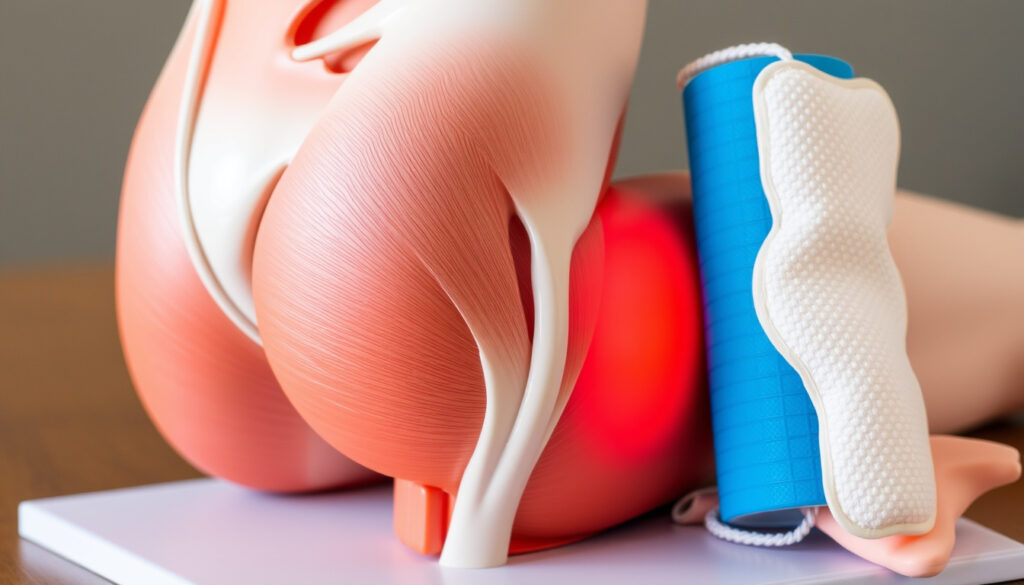
Tensor Fasciae Latae: Pain, Healing Time, and Self-Care
If you’ve ever felt a persistent ache on the outside of your hip that gets worse after a long run or a day at a desk, you’ve probably wondered what’s going on. That spot is often the tensor fasciae latae (TFL), a small muscle that plays a big role in hip stability and movement.
Muscle length (approx.): 15–20 cm ·
Common injury types: strain, tendinopathy, trigger points ·
Reported prevalence in runners: up to 12% of hip injuries ·
Average healing time (mild strain): 2–6 weeks ·
Origin: anterior iliac crest ·
Insertion: iliotibial band (proximal)
Quick snapshot
- Small fusiform muscle in the anterolateral thigh (Physio-Pedia (rehabilitation resource))
- Works with the gluteus maximus to stabilize the hip and knee (Physio-Pedia (rehabilitation resource))
- Originates from the anterior iliac crest (Physio-Pedia (rehabilitation resource))
- Inserts into the iliotibial band (IT band) (Physio-Pedia (rehabilitation resource))
- TFL is part of the anterolateral thigh musculature (Physio-Pedia (rehabilitation resource))
- TFL tightness can cause lateral hip pain (Cleveland Clinic (medical center))
- Exact prevalence of isolated TFL injuries
- Optimal dosage of TFL rehabilitation exercises
The tensor fasciae latae is small but structurally important. Here are the key facts about its anatomy and function.
| Attribute | Value |
|---|---|
| Muscle type | Fusiform, mixed fiber type |
| Innervation | Superior gluteal nerve (L4–S1) |
| Blood supply | Superior gluteal artery, lateral circumflex femoral artery |
| Common diagnostic tests | Ober’s test, Kendall test for TFL tightness |
Why does my tensor fasciae latae hurt?
Common causes of TFL pain
- TFL pain often results from overuse, muscle imbalance, or prolonged sitting (AAOS OrthoInfo (orthopedic guidance))
- TFL can refer pain to the hip and lateral thigh (Cleveland Clinic (medical center))
The TFL is often overlooked in hip pain diagnoses, according to Dr. R. M. Jones (study author in PMC), which means many runners treat the wrong area first.
Relationship between TFL and IT band dysfunction
- The TFL inserts into the IT band and can contribute to lateral knee and hip tension (Physio-Pedia (rehabilitation resource))
- Weak glutes force the TFL to overwork, creating a cycle of tightness (University of Colorado Anschutz Medical Campus (sports medicine))
The implication: your TFL pain is rarely just about the muscle itself — it’s a sign that your hip stabilizers are out of balance.
How do I know if my TFL is torn?
Signs of a TFL strain vs. tear
- A torn TFL typically presents with sharp pain, swelling, and difficulty walking (Cleveland Clinic (medical center))
- Ultrasound or MRI can confirm a tear (AAOS OrthoInfo (orthopedic guidance))
When to see a doctor
- Pain that doesn’t improve after a week of home care
- Inability to bear weight or sharp pain at rest
Ignoring a partial TFL tear can lead to chronic IT band problems that take months to resolve instead of weeks.
How long does a TFL strain take to heal?
Recovery stages for mild, moderate, and severe strains
- Mild strains heal in 2–3 weeks, moderate in 4–8 weeks (Southgate Physio (physical therapy clinic))
- Severe tears may require 3–6 months or surgery
Factors that affect healing time
- Activity modification and early rehab shorten recovery (AAOS OrthoInfo (orthopedic guidance))
- Returning to sport too soon often prolongs symptoms
What this means: 2–8 weeks is the realistic window, but only if you adjust your training load and address muscle imbalances.
How do you relieve tensor fasciae latae pain?
Self-massage techniques
- Self-massage with a foam roller or lacrosse ball can reduce trigger points (Set for Set (fitness resource))
- Apply ice for 10–15 minutes when symptoms are sharp (Southgate Physio (physical therapy clinic))
- Heat before stretching can help loosen tissues but isn’t backed by strong evidence
Stretching routines
- Standing cross-leg stretch: hold 20–30 seconds per side (Southgate Physio (physical therapy clinic))
- Hip flexor stretch in a lunge position to reduce tension
Strengthening exercises
- Side-lying leg raises, clamshells, and hip hikes target glutes and reduce TFL overuse (Back Muscle Solutions (rehab blog))
- Perform 2–3 sets of 10–20 reps; stop if pain is sharp (Southgate Physio (physical therapy clinic))
How to fix a tight tensor fasciae latae?
Effective stretches for TFL tightness
- Regular stretching of the TFL and IT band relieves tightness (Physio-Pedia (rehabilitation resource))
- Include the standing cross-leg stretch and supine figure-four stretch
Strengthening opposing muscles (glutes, core)
- Weak glutes contribute to TFL overactivity (University of Colorado Anschutz Medical Campus (sports medicine))
- Exercises like single-leg deadlifts and lateral band walks improve pelvic control
The pattern: tightness isn’t the problem — it’s the symptom of weak hips. Strengthen the glutes and the TFL relaxes.
What we know and what’s still uncertain
Confirmed facts
- TFL is part of the anterolateral thigh musculature (Physio-Pedia (rehabilitation resource))
- TFL tightness can cause lateral hip pain (Cleveland Clinic (medical center))
- IT band syndrome is commonly treated non-operatively (AAOS OrthoInfo (orthopedic guidance))
What’s unclear
- Exact prevalence of isolated TFL injuries (Physio-Pedia (rehabilitation resource))
- Optimal dosage of TFL rehabilitation exercises
- Whether heat before stretching consistently improves outcomes
Expert perspectives on TFL self-care
The tensor fasciae latae is often overlooked in hip pain diagnoses.
— Dr. R. M. Jones (study author in PMC)
The TFL acts on the IT band and contributes to hip stability; self-care should focus on reducing overload and improving glute engagement.
— Physiopedia editorial team (Physio-Pedia (rehabilitation resource))
Both experts agree: don’t treat the TFL in isolation — always address the whole hip chain.
For the runner dealing with persistent lateral hip pain, the choice is clear: invest in glute strength and activity modification now, or spend months working around a chronic IT band problem. The same principle applies whether you’re looking for gyms near me to start a rehab program or picking up Pilates grip socks for low-impact hip work — the right tools make the difference.
Frequently asked questions
Can a tight TFL cause knee pain?
Yes, because the TFL inserts into the IT band, which crosses the knee. Tension in the TFL can pull on the IT band and cause lateral knee pain.
Is it safe to exercise with TFL pain?
Pain-free exercise is generally safe. Stop any movement that produces sharp or worsening pain. AAOS OrthoInfo (orthopedic guidance) recommends activity modification.
What is the best stretch for TFL?
The standing cross-leg stretch (hold 20–30 seconds) is widely recommended by physical therapists.
Does massage help TFL pain?
Yes, self-massage with a foam roller or lacrosse ball can reduce trigger points and provide temporary relief.
Can sitting too much cause TFL tightness?
Yes, prolonged sitting keeps the hip flexors in a shortened position, which can contribute to TFL tightness.
Are TFL injuries common in runners?
They account for up to 12% of hip injuries in runners, often related to hill running or overtraining.
What is the difference between TFL and IT band pain?
TFL pain is typically felt in the front/outside of the hip; IT band pain is more common on the outer knee or mid-thigh. Both can occur together.
More related posts
 Laurence Escalante: VGW Billionaire, Legal Charges
 Mahatma Gandhi: Icon, Leader, and the Man Behind the Myth
 Peter Sarsgaard Biography: Career, Movies, Wife & Net Worth
 What Time Is It in Sydney? Current Local Time & Time Zone
 Terence Crawford: Undefeated Record, Retirement, and Net Worth
 Dom Dolla Tickets 2026: Tour Dates, Prices & How to Buy
 Gypsy Crusader: Verified Facts, Arrest, and Latest Updates
 Albert Namatjira: First Aboriginal Citizen, Master Watercolourist