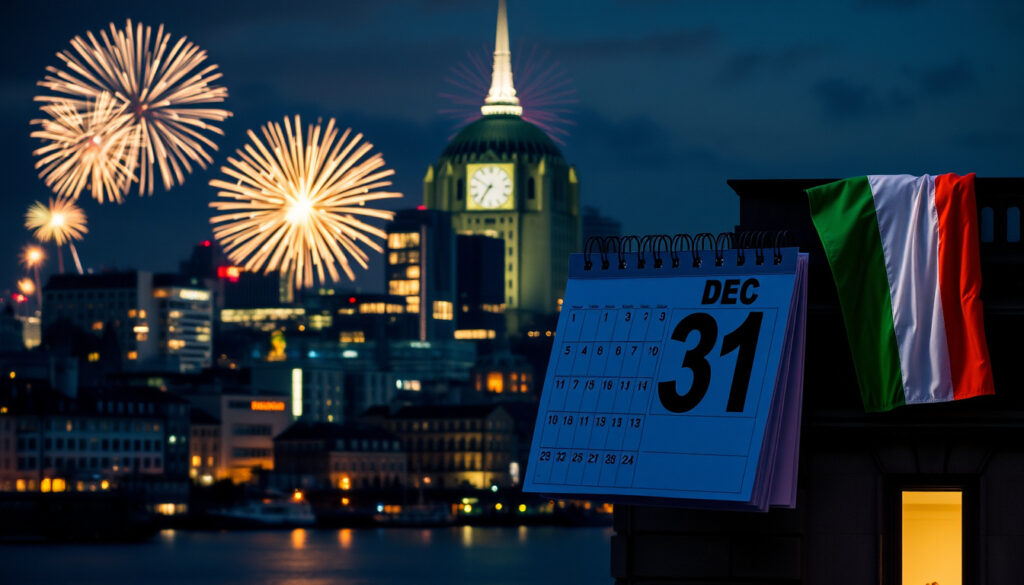
Is New Year’s Eve a Public Holiday? (Ireland & Beyond)
Wondering whether New Year’s Eve is a day you can officially take off in Ireland? The answer might catch you off guard: while New Year’s Day is a public holiday, December 31 remains a normal working day with no automatic paid day off.
Public holidays in Ireland (per year): 10 ·
New Year’s Day (Jan 1) status: Public holiday ·
New Year’s Eve (Dec 31) status: Not a public holiday ·
Bank holiday designation for NYE: No
Quick snapshot
- New Year’s Eve is not a public holiday in Ireland (Workplace Relations Commission)
- New Year’s Day is a public holiday (Workplace Relations Commission)
- There are 10 public holidays per year in Ireland (Workplace Relations Commission)
- Whether individual employers grant paid time off for New Year’s Eve (depends on contract)
- Whether New Year’s Eve is considered a holiday in Northern Ireland (varies by region)
- Whether New Year’s Eve is considered a half-day in some workplaces (varies by employer)
- 2022: Public holidays in Ireland increased from 9 to 10 (Workplace Relations Commission)
- 2023: First Monday in February added as a public holiday (Workplace Relations Commission)
- Before every New Year’s Eve, check your employment contract – employers may grant early closure voluntarily but are not required
- Northern Ireland’s holiday list differs; verify if you cross the border
Ten official holidays, yet New Year’s Eve is not among them. The table below shows the key facts at a glance.
| Fact | Detail |
|---|---|
| Status in Ireland | Not a public holiday |
| Number of public holidays | 10 |
| Next public holiday after Christmas | New Year’s Day (January 1) |
| Public holiday pay entitlement | Only applies to designated public holidays |
Is New Year’s Eve a public holiday in Ireland?
What are the 10 public holidays in Ireland?
- New Year’s Day (1 January) (Ireland.com)
- First Monday in February (or 1 February if it falls on a Friday) (Citizens Information)
- St. Patrick’s Day (17 March)
- Easter Monday
- First Monday in May
- First Monday in June
- First Monday in August
- Last Monday in October
- Christmas Day (25 December)
- St. Stephen’s Day (26 December)
The list, published by the Workplace Relations Commission, includes ten days – and New Year’s Eve is absent. The upshot: December 31 is legally a standard working day.
How does New Year’s Eve differ from New Year’s Day?
New Year’s Day is one of those ten official holidays. That means banks, most shops, and many businesses close, and public transport runs on restricted schedules, as noted by Ireland.com (official tourism website). New Year’s Eve enjoys none of those guarantees. Instead, it’s a normal working day unless your employer decides otherwise. The implication: the calendar flip from Dec 31 to Jan 1 represents a stark boundary between workday and holiday.
The night most people celebrate the new year is not a holiday, but the hangover day is. For workers, that means a full day of work on Dec 31 followed by a paid day off on Jan 1 – a trade-off that catches many by surprise.
Is New Year’s Day a bank holiday in Ireland?
What is the difference between a public holiday and a bank holiday?
In Ireland the two terms are often used interchangeably, but the origins differ. Public holidays are set by statute (the Holidays (Employees) Act and subsequent regulations), whereas bank holidays originally referred to days when banks closed. In practice, the same ten days are observed as both. According to the Workplace Relations Commission, the public holiday list includes New Year’s Day, and banks close on that day.
Are banks closed on New Year’s Day in Ireland?
Yes, banks close on New Year’s Day. Most retail outlets and pubs also shut their doors, and public transport operates under restrictions, per Ireland.com. The pattern is consistent across the Republic. The catch: while banks close on Jan 1, they remain open on Dec 31 – so if you need to finish year‑end banking, do it before midnight on the 30th.
Is New Year’s Eve a paid bank holiday?
What are the pay rules for public holidays in Ireland?
Public holiday pay entitlements apply only to the ten designated public holidays. The Workplace Relations Commission explains that employees who work on a public holiday must be paid at their agreed rate plus receive a public holiday benefit (such as an additional day’s pay or an extra day of annual leave). Part‑time workers qualify if they have worked at least 40 hours in the previous five weeks.
Do part-time workers get paid for New Year’s Eve?
Because New Year’s Eve is not a public holiday, those pay rules do not apply. Part‑time workers have no automatic entitlement to paid time off on Dec 31. However, if New Year’s Eve happens to be a normal working day included in their contract, they are paid their usual rate – no bonus. The odds: employers may voluntarily offer early closure or a token bonus, but legally, it’s just another working day.
For the roughly 450,000 part‑time workers in Ireland, the absence of public holiday status on Dec 31 means no extra pay or day in lieu. The only protection comes from their individual employment agreement.
Is New Year’s Eve a working day?
What if New Year’s Eve falls on a weekend?
When New Year’s Eve lands on a Saturday or Sunday, it remains a non‑public holiday. There is no automatic day in lieu. Employers are not required to give an alternative day off, though some may offer flexibility. The Workplace Relations Commission confirms that public holiday entitlements (including substituted days) apply only to the ten official holidays – New Year’s Eve is not one of them.
Can employers require work on New Year’s Eve?
Yes. Since New Year’s Eve is a normal working day, employers can schedule work as usual. There is no legal prohibition. However, many Irish employers voluntarily grant early closing on Dec 31, especially in office and retail settings. But that’s a matter of workplace policy, not law. The rule of thumb: if it’s a weekday, expect to work unless told otherwise.
Does December 31 count as a holiday?
Is December 31 considered a holiday in other countries?
Treatments vary. In the United Kingdom, New Year’s Eve is not a bank holiday, but some regions observe it as a half‑day. In Australia, New Year’s Eve is a public holiday in some states (e.g., New South Wales) but not in others. According to Discovering Ireland Vacations (travel information site), Northern Ireland’s holiday schedule differs from the Republic’s, with ten public holidays that include New Year’s Day but not New Year’s Eve.
How do other countries treat New Year’s Eve?
In the United States, New Year’s Eve is not a federal holiday – federal offices remain open. Many private companies give a half‑day, but there is no federal mandate. The contrast with Ireland is minimal: both jurisdictions treat Dec 31 as a regular working day, while Jan 1 is a public holiday. The trade‑off: the celebration comes with an expectation that you’ll show up to work the next day (or have the day off if it falls on a weekend).
“There are 10 public holidays in Ireland each year … New Year’s Day is one of them.”
Workplace Relations Commission
“Public holiday pay is only due on the 10 public holidays.”
Workplace Relations Commission
“Most shops and pubs are closed on New Year’s Day, and public transport operates but under restrictions.”
Ireland.com (official tourism website)
Confirmed facts
- New Year’s Eve is not a public holiday in Ireland (Workplace Relations Commission).
- New Year’s Day is a public holiday in Ireland (Workplace Relations Commission).
- There are 10 public holidays per year in Ireland (Workplace Relations Commission).
What’s unclear
- Whether individual employers grant paid time off for New Year’s Eve (depends on contract).
- Whether New Year’s Eve is considered a holiday in Northern Ireland (varies by region).
- Whether New Year’s Eve is treated as a half-day in some workplaces (varies by employer).
What the regulators say
For Irish workers, the choice on New Year’s Eve is clear: either enjoy a normal day’s work and then celebrate, or ask your employer for flexibility – but the law gives you no right to the day off. Without a statutory holiday designation, December 31 remains a working day; any time off is a gift from your employer, not an entitlement.
en.wikipedia.org, hogansirishcottages.com, officeholidays.com
Frequently asked questions
Is New Year’s Eve a half-day at work?
No, there is no legal requirement for a half-day. Some employers grant early closing voluntarily.
Does New Year’s Eve affect public transport schedules?
Public transport usually runs on a normal schedule on Dec 31. Reduced services are common on New Year’s Day.
What about Northern Ireland? Is New Year’s Eve a holiday there?
Northern Ireland does not list New Year’s Eve as a public holiday. Its public holiday schedule includes New Year’s Day but not Dec 31.
Is New Year’s Eve a public holiday in the United Kingdom?
No. New Year’s Eve is not a public holiday in England, Scotland, Wales, or Northern Ireland.
Do schools close on New Year’s Eve in Ireland?
Schools are typically on Christmas break until after New Year’s Day, so students are not affected by the working-day status of Dec 31.
Can I refuse to work on New Year’s Eve?
Refusing to work on a normal working day without a valid reason may breach your employment contract. Check your contract or union agreement.
Related reading
More related posts
 Nedd Brockmann: Run, Injuries, and Life After
 Bronny James: Height, Cardiac Arrest, Net Worth, and NBA Career
 Garry Pankhurst: What Happened to Skippy’s Sonny Now
 Cristiano Ronaldo Jr: Age, Height, Mother, and Career
 Dom Dolla Tickets 2026: Tour Dates, Prices & How to Buy
 Is Gastro Contagious? Spread, Duration & Prevention Guide
 Homemade Beef Chow Mein: 25 Minute Recipe Like Takeout
 Alan Dershowitz: Trump, OJ Simpson, and Controversies