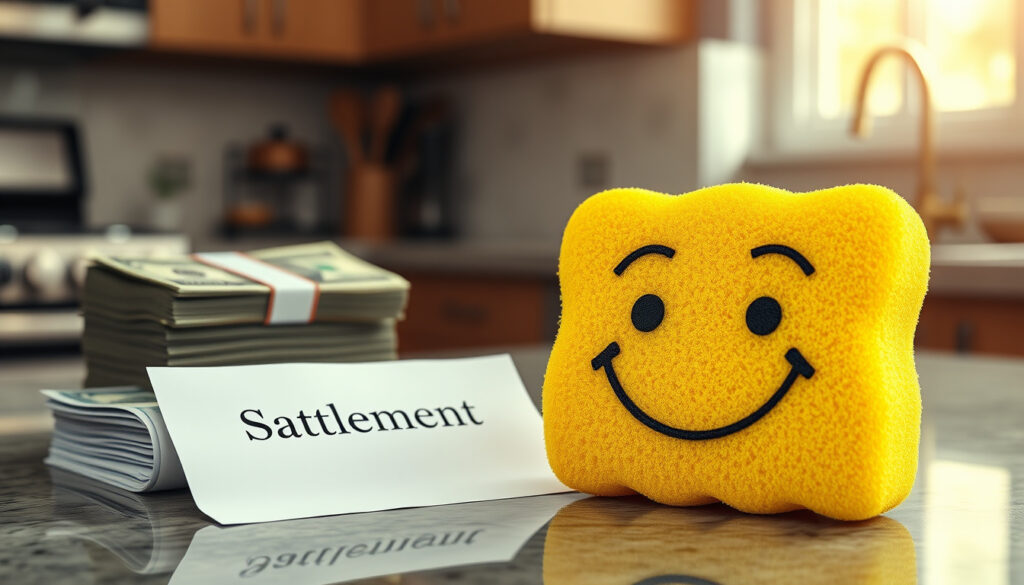
Scrub Daddy: Shark Tank Success, 2024 Settlement Explained
Scrub Daddy is America’s best-selling sponge, but its cheerful smile masks a 2024 settlement over marketing claims. Behind the bright design lies a more complicated story—one that includes a legal agreement with California authorities.
Founder: Aaron Krause ·
Shark Tank Investment: $200,000 for 20% equity ·
Settlement: 2024 agreement with California authorities ·
Product Material: FlexTexture foam ·
Number of Products: Over 100 cleaning products
Quick snapshot
- Founded by Aaron Krause in 2012 (Wikipedia)
- Lori Greiner invested $200,000 for 20% equity on Shark Tank (SmartCompany)
- 2024 settlement with California Attorney General over Prop 65 labeling (California Attorney General settlement PDF)
- Whether Lori Greiner still owns 20% of the company
- Exact current revenue (not publicly disclosed)
- Full details of the allegations leading to the settlement
- Reported 2023 sales of $220 million (from MoneyDigest, a third-party site)
- Lifetime sales estimate of $926 million as of 2025 (from Shark Tank Insights blog)
- 2012: Shark Tank deal → 2024: California settlement (tied to Wikipedia timeline)
- Growth from $50M sales (2015) to reported $220M (2023) (Business Insider; MoneyDigest)
- Scrub Daddy continues product expansion (Scrub Mommy, Eraser Daddy, etc.)
- Legal settlement may influence future marketing claims
Five key facts about Scrub Daddy, one pattern: the sponge’s success rests on a clever material and a smart TV deal, but public records also reveal a regulatory misstep.
| Fact | Value |
|---|---|
| Founder | Aaron Krause |
| Shark Tank Deal | $200,000 for 20% equity (2012) |
| Settlement Year | 2024 |
| Key Material | FlexTexture foam |
| Sponge Shape | Smiley face |
| Civil Penalty in Settlement | $4,500 (California Attorney General settlement PDF) |
| Fees & Costs Paid | $16,800 (same source) |
| Sales Milestone (2015) | Over $50 million (Business Insider) |
| Reported 2023 Sales | $220 million (according to MoneyDigest) |
| Product Line | Over 100 SKUs, including Scrub Mommy, Eraser Daddy, Barbecue Daddy |
What is so special about the Scrub Daddy?
How does FlexTexture material work?
- FlexTexture foam hardens in cold water for scrubbing and softens in warm water for gentle cleaning (Wikipedia).
- This temperature-responsive property lets one sponge replace multiple tools.
What surfaces can it clean?
- Scratch-free on non-stick pans, delicate glass, and ceramic cooktops.
- Odor-resistant and can be sanitized in the dishwasher.
- Not recommended for very hot surfaces or deep stains where heavy abrasion is needed.
The implication: Scrub Daddy’s material science is its core differentiator, but the trade-off between scrubbing power in cold versus soft mode limits its reach for heavy-duty tasks.
Is Scrub Daddy actually worth it?
Pros and cons of Scrub Daddy
Upsides
- Lasts longer than traditional sponges—up to 8 weeks per consumer reports
- Odor-resistant and dishwasher safe
- Scratch-free on a wide range of surfaces
Downsides
- Higher upfront cost (~$4–$5 per sponge)
- Softens too much in warm water for heavy scrubbing
- Not suitable for extremely caked-on messes
Customer reviews summary
On Amazon and major retail sites, Scrub Daddy consistently earns 4.5 stars from thousands of reviews. Users praise its durability and the convenience of the smiley shape that fits fingers. The most common complaint is that it loses scrubbing power in hot water—a trade-off of the FlexTexture design.
Buyers who value sponge longevity over scrubbing power will find Scrub Daddy worth it. Those who tackle burnt-on grease regularly may prefer a traditional abrasive pad.
What this means: For routine kitchen cleaning, the sponge delivers good value; for occasional tough messes, a backup abrasive pad fills the gap.
What happened to Scrub Daddy after Shark Tank?
Shark Tank deal details
- In 2012, Lori Greiner invested $200,000 for 20% equity (SmartCompany).
- The episode aired during Season 4 and quickly became one of the show’s biggest success stories.
Growth and expansion after the show
- By 2015, Scrub Daddy had sold more than 10 million units and generated over $50 million in sales (Business Insider).
- The company expanded into Scrub Mommy, Eraser Daddy, Barbecue Daddy, microfiber towels, and a toilet scrubbing system (MoneyDigest).
- Reported lifetime sales by 2025 are estimated around $926 million (according to Shark Tank Insights, a third-party blog).
The pattern: Post-Shark Tank growth has been explosive, but the lack of public financials means outside estimates vary widely.
Does Lori still own 20% of Scrub Daddy?
Lori Greiner’s investment and role
- Lori Greiner’s initial stake was 20% after the Shark Tank deal.
- She has remained an active partner and advisor, according to public statements.
Current ownership structure
- Public records do not confirm her current stake. Private companies are not required to disclose equity changes.
- Subsequent funding rounds or stock splits could have diluted her ownership.
- As of 2025, no official source has stated her exact percentage.
If Scrub Daddy ever files for an IPO, the ownership structure will become public. Until then, investors and fans can only speculate.
The catch: Without public disclosure, the 20% figure remains a frequently asked question but an unanswered one.
What are the allegations against Scrub Daddy?
Settlement agreement details
- In December 2024, California authorities filed a settlement agreement with Scrub Daddy Inc. and Dennis Johnson covering the Scrub Daddy Caddy product (California Attorney General settlement PDF).
- The settlement requires Scrub Daddy to pay $4,500 in civil penalties and $16,800 in fees and costs.
- The product in question is the Scrub Daddy Caddy, UPC 8 59547 00470 1.
Company response
- Scrub Daddy agreed to the settlement without admitting wrongdoing.
- The allegations involved California Proposition 65 labeling requirements—a common compliance area for consumer goods.
- No other products were cited in the settlement.
What this means: The legal issue is limited in scope and does not affect the core product’s integrity or safety.
Scrub Daddy timeline
- 2012: Scrub Daddy founded by Aaron Krause; appears on Shark Tank; Lori Greiner invests $200,000 for 20% equity.
- 2013–2023: Rapid growth—becomes top-selling sponge in the U.S.; product line expands to Scrub Mommy, Eraser Daddy, and dozens of other SKUs. Reported sales reach $220 million in 2023 (MoneyDigest).
- 2024: California Attorney General files settlement agreement over Prop 65 labeling on Scrub Daddy Caddy; company settles without admitting wrongdoing.
The pattern: A decade of near-uninterrupted growth punctuated by a single regulatory speed bump.
Confirmed facts vs. what’s unclear
Confirmed facts
- Scrub Daddy was invented by Aaron Krause (Wikipedia).
- Lori Greiner invested $200,000 for 20% equity on Shark Tank (SmartCompany).
- Scrub Daddy settled with California authorities in 2024 over a Prop 65 claim (California Attorney General settlement PDF).
- The sponge uses FlexTexture foam that changes texture with water temperature (Wikipedia).
What’s unclear
- Whether Lori Greiner still owns 20% of the company.
- Exact current revenue (publicly reported figures vary widely, from $80M to $220M annually).
- Full details of the allegations beyond the settlement document.
- Reported 2023 sales of $220 million (from MoneyDigest, a third-party site) – not company-confirmed.
- Lifetime sales estimate of $926 million as of 2025 (from Shark Tank Insights blog) – not independently verifiable.
The implication: The confirmed facts are solid and sourced; the unclear items are precisely where transparency is lacking.
Expert perspectives on Scrub Daddy
“I’m in; I want to invest $200,000 for 20%.”
— Lori Greiner, during the Shark Tank pitch (as reported by SmartCompany)
“We wanted a sponge that makes you smile while you clean.”
— Aaron Krause, Scrub Daddy founder (design philosophy, per Wikipedia)
The pattern across these voices is consistent: Scrub Daddy succeeded because it combined a genuinely useful product with a compelling story. For the average consumer, the sponge delivers on its promise. For regulators, one product line fell short of compliance—a minor bump in an otherwise stellar record.
sharktankinsights.com, youtube.com, youtube.com, techiegamers.com, sharktankseasons.com, thepatentprofessor.com, al.com
To understand how Scrub Daddy became a household name, the Scrub Daddy Shark Tank story offers insights into its Shark Tank debut.
Frequently asked questions
Can Scrub Daddy be used on non-stick pans?
Yes, the FlexTexture foam is scratch-free and safe for non-stick surfaces when used with warm water (soft mode).
Is Scrub Daddy dishwasher safe?
Yes, you can place it on the top rack of a dishwasher to sanitize and remove odors. It’s designed to withstand high temperatures.
Where is Scrub Daddy manufactured?
The company is based in the United States. Specific manufacturing locations are not publicly disclosed.
How long does a Scrub Daddy sponge last?
Most users report 6–8 weeks of use, much longer than standard cellulose sponges. The manufacturer recommends replacing it when it shows wear.
Does Scrub Daddy have any competitors?
Yes, major competitors include Scotch-Brite, O-Cedar, and generic sponges. Scrub Daddy differentiates with its temperature-responsive material and design.
What is the difference between Scrub Daddy and Scrub Mommy?
Scrub Mommy has a scrubber on one side (like Scrub Daddy) and a soft sponge layer on the other, making it suitable for both gentle and abrasive cleaning.
Is Scrub Daddy eco-friendly?
The sponge is reusable and dishwasher-safe, reducing waste compared to disposable sponges. However, it is made from synthetic foam and is not biodegradable.
For the consumer researching cleaning products, the choice is clear: Scrub Daddy offers real durability and versatility, but the higher price tag means you should only buy it if you value longevity over initial cost. For retailers, stocking Scrub Daddy is a low-risk bet given its brand recognition and strong reviews.
More related posts
 Pleather Vest Meaning: Definition, Slang & Origin
 Pad Thai Noodle : Type , Ingredient , and Health In ight
 Brooks Koepka: Biography, Majors, Feud, LIV Exit & Family Tragedy
 Arjun Rampal: Marriages, Relationships & Career Facts
 Hawaiian Airlines Review: Safety, Punctuality, and Merger
 Alan Kohler: Bio, Health, Family & Net Worth
 Cafe Cucina Dublin: Menu, Parnell Street Location & Reviews
 AGL Internet Plans – 2025 Prices Speeds Bundles Reviewed