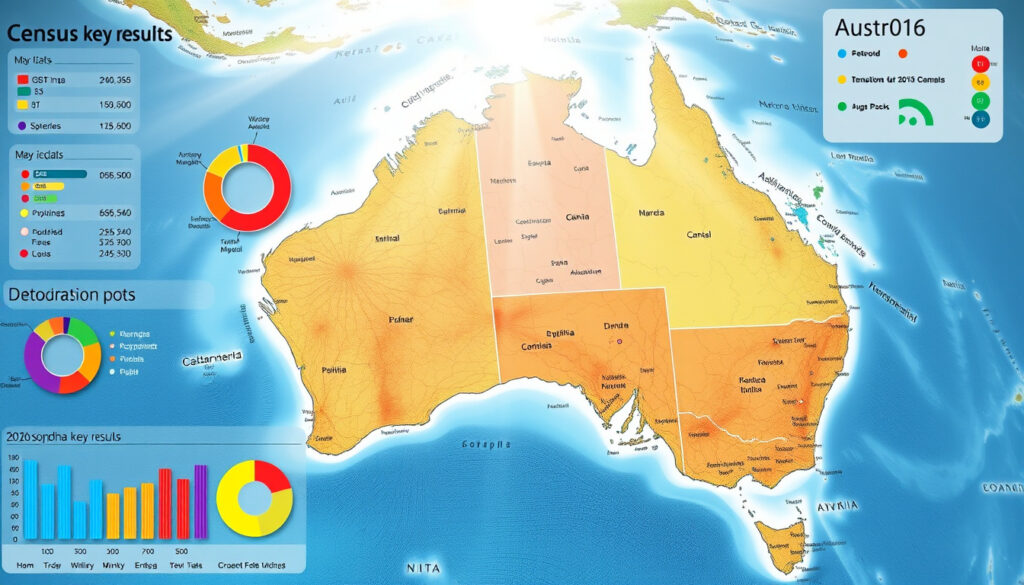
Census Australia 2016 – Key Results and Data Access
The 2016 Australian Census stood as the most comprehensive snapshot of the nation’s population, capturing detailed information from over 23 million residents across approximately 10 million dwellings. Conducted by the Australian Bureau of Statistics on 9 August 2016, the census gathered data on demographics, religion, language, employment, and household composition that continues to inform policy decisions, research, and community planning today.
The results revealed significant shifts in Australia’s religious landscape, a growing secular population, and notable changes in how Australians identified themselves culturally and spiritually. Understanding these findings requires access to the official data tools provided by the ABS, particularly the QuickStats system that allows users to explore results at national, state, and suburb levels.
This guide examines the key findings from the 2016 census, explains how to access the full dataset, and contextualizes the results within broader historical trends that shaped contemporary Australia.
What Were the Key Results of the 2016 Australian Census?
The 2016 Census recorded a total population of 23,401,892 people in Australia, representing an 8.8 percent increase from the 2011 count of 21,507,719. This growth reflected both natural increase and substantial net overseas migration during the intervening five years. The census night saw approximately 10 million dwellings counted, with the data collection process spanning every state and territory across the continent.
The data painted a picture of an increasingly diverse and secular nation. While Christianity remained the largest religious affiliation when excluding the “not stated” category, the proportion had fallen dramatically over the preceding decades. The number of people identifying with no religion surged past 6.9 million, representing a substantial demographic shift that accelerated after 2011.
State-level variations emerged clearly in the results. New South Wales recorded the highest rate of religious affiliation at 66 percent, while Tasmania showed the lowest at 53 percent. These differences reflected the urban-rural divide, immigration patterns, and the concentration of particular community groups in specific regions that characterized Australian settlement patterns.
- Population grew by 1.9 million people since 2011, the largest five-year increase in census history
- 49.3 percent of the population identified as male, with the balance reflecting an aging demographic
- Over 2.2 million more people identified as having no religion compared to 2011
- Christianity overall (excluding not stated) stood at 57.7 percent of the population
- Non-Christian religions grew to 8.2 percent of the population from 5.6 percent in 2006
- The “not stated” category represented 9.6 percent, or 2.2 million people
- Diversity themes and population changes detailed extensively in the “Reflecting Australia” report
| Metric | 2016 Value | Change from 2011 |
|---|---|---|
| Total Population | 23,401,892 | +8.8% |
| No Religion | 29.6% (6.9 million) | ↑ from 21.8% |
| Catholic | 22.6% (5.3 million) | ↓ from 25.3% |
| Anglican | 13.3% | ↓ from 17.1% |
| Uniting Church | 3.7% | ↓ from 5.0% |
| Not Stated | 9.6% (2.2 million) | ↑ from 9.2% |
Where Can I Access 2016 Census Data Online and PDF?
The Australian Bureau of Statistics provides several official pathways for accessing 2016 Census data. The primary interface is the QuickStats system, which offers pre-compiled summaries of population, religion, and demographics organized by geographic area. Users can search by area code or navigate through national, state, and suburb-level data without requiring specialized statistical software.
Using the QuickStats System
The ABS QuickStats pages deliver interactive tables that compare local area percentages against state and national figures. For example, searching the national data at area code 0 reveals the complete picture for Australia, while suburb-specific codes like SSC10109 for Austral in New South Wales provide granular local information.
Each QuickStats page includes data quality statements for the Religious affiliation field (RELP), helping users understand the reliability of specific figures. The interface also presents top religions for each area, enabling direct comparisons between regions. A complete guide to QuickStats functionality is available through the ABS Census data tools documentation.
The QuickStats system is entirely web-based, with no direct PDF download options for individual area reports. For comprehensive dataset downloads, custom queries, and detailed cross-tabulations, the ABS TableBuilder tool provides advanced access to the full census microdata.
Supplementary Resources and Reports
Beyond the interactive QuickStats interface, the ABS published several analytical reports that contextualize the 2016 Census findings. The “Reflecting Australia” publication examines population diversity, migration patterns, and cultural change using census data as its foundation. The Religion Data Summary provides specific analysis of the religious affiliation trends visible in the 2016 results.
The Census Dictionary offers definitions for all variables collected during the survey, including the RELP field that measures religious affiliation. Understanding these definitions helps users interpret the data correctly, particularly regarding how the “not stated” category is handled in percentage calculations.
For those seeking broader context, the official ABS census homepage for 2016 provides an entry point to all available resources, data releases, and announcements related to the census cycle.
What Were the Religion Statistics from the 2016 Census?
The religious composition of Australia underwent significant transformation in the 2016 Census. Christianity remained the largest religious group at 52 percent of the population when excluding the “not stated” category, but this figure represented a continuation of a decades-long decline. In 1966, Christians constituted 88 percent of Australians; by 1991 the proportion had fallen to 74 percent, and by 2016 it had reached 57.7 percent.
Christian Denominations in Decline
Catholicism maintained its position as the largest single Christian denomination at 22.6 percent, representing approximately 5.3 million Australians. However, this marked a decline from 25.3 percent in 2011, continuing a pattern of gradual erosion that reflected broader secularization trends. The Anglican Church experienced an even sharper decline, falling from 17.1 percent in 2011 to 13.3 percent in 2016.
The Uniting Church showed the most dramatic decline among major denominations, dropping from 5.0 percent in 2011 to just 3.7 percent in 2016. This fall reflected both demographic aging in traditional Methodist and Presbyterian congregations and the broader movement away from institutional religious affiliation.
The Rise of No Religion
Perhaps the most striking finding concerned the surge in Australians identifying with no religion. This group reached 29.6 percent of the population in 2016, equivalent to 6.9 million people. The increase from 21.8 percent in 2011 represented an additional 2.2 million people choosing non-religious identification in just five years. The trend accelerated sharply after 2011, having grown from 19 percent in 2006.
The “not stated” category, which includes people who did not answer the religion question, stood at 9.6 percent or 2.2 million people. This category is distinct from those who explicitly identified as having no religion, though some researchers suggest partial overlap between the groups.
Growth in Non-Christian Religions
Non-Christian religions expanded significantly during the 2011-2016 period. Islam grew to 2.6 percent of the population and Buddhism to 2.4 percent, reflecting immigration patterns particularly from Southeast Asia and the Middle East. Hinduism saw particularly strong growth from 2006 levels, driven by skilled immigration from South Asian countries.
Percentage calculations for religious groups typically exclude the “not stated” category from the denominator. This methodological choice, standard in ABS reporting, means that percentages for each religion sum to more than 100 percent when combined, as “no religion” and individual faiths are measured against those who provided an answer rather than the total population.
| Religion | 2016 Percentage | 2011 Percentage | Direction |
|---|---|---|---|
| No Religion | 29.6% | 21.8% | Strong increase |
| Catholic | 22.6% | 25.3% | Decrease |
| Anglican | 13.3% | 17.1% | Decrease |
| Uniting Church | 3.7% | 5.0% | Decrease |
| Islam | 2.6% | 2.2% | Increase |
| Buddhism | 2.4% | 2.5% | Slight decrease |
How Does the 2016 Census Compare to Other Years?
Understanding the 2016 Census requires placing it within the longer trajectory of Australian census history. The first comprehensive national census was conducted in 1911, establishing a tradition of five-yearly data collection that continues today. Each census builds upon previous findings, allowing researchers to track demographic shifts across generations.
Long-Term Religious Decline
The decline of Christianity in Australia spans the entire modern census era. In 1966, Christians comprised 88 percent of the population, a proportion that had fallen to 74 percent by 1991. The 2016 figure of 57.7 percent represents the first census where Christians formed a minority of those stating a religious affiliation. This trajectory suggests continued erosion in subsequent years, though 2021 data provides the most current comparison point.
The acceleration after 2011 proved particularly notable. Between 2006 and 2011, the “no religion” category grew by approximately 2.8 percentage points. Between 2011 and 2016, the increase reached 7.8 percentage points, representing more than double the previous rate of growth.
Urban Diversity: Sydney and Brisbane
Population centers like Sydney and Brisbane demonstrate how migration patterns influence local religious composition. New South Wales as a whole recorded No religion at 25.1 percent, Catholic at 24.7 percent, Anglican at 15.5 percent, and Islam at 3.6 percent, with an overall religious affiliation rate of 66 percent.
Specific suburbs show even more pronounced patterns. Austral, a suburb in Sydney’s southwest, recorded Catholic affiliation at 47.7 percent, the highest concentration of any single religion in the sample areas examined. Christianity overall reached 77.4 percent in Austral, while No religion stood at just 9.8 percent. These figures reflect the area’s established Italian-Australian community and recent Vietnamese immigration.
By contrast, the Page federal electorate in New South Wales showed No religion as the top category at 29.0 percent, nearly matching the national average of 29.6 percent. Catholic and Anglican percentages in Page both sat around 20 percent, reflecting a more evenly distributed religious landscape typical of regional coastal areas.
City-wide QuickStats for Sydney and Brisbane were not directly available in the 2016 results examined. The figures above represent state-level data and specific suburb or electorate examples. For comprehensive city-wide comparisons, users should consult the relevant state QuickStats pages or the full national dataset.
Looking Forward: 2021 Census Context
The 2021 Census provides the next benchmark for comparison. While detailed 2021 results were not available within the scope of this review, the ABS has noted that the trends visible in 2016 continued apace. Available indicators suggest that the proportion of Australians identifying with no religion rose further, potentially approaching 38 percent, though official confirmation requires consulting the full 2021 release.
For researchers tracking these trends, the historical comparisons between 2011, 2016, and 2021 censuses offer invaluable insight into the pace and nature of Australia’s cultural transformation. Each census captures a moment in this ongoing evolution, with the data tools provided by the ABS allowing interested users to conduct their own analyses across the full timeframe.
Key Dates in the 2016 Census Cycle
The 2016 Census followed a predictable timeline from initial planning through data release. Understanding this sequence helps contextualize when and how the results became available to researchers, policymakers, and the general public.
- 2015-2016: Planning and preparation phases conducted by the ABS, including questionnaire development and field staff recruitment
- 9 August 2016: Census night, when all households were asked to complete forms reflecting their circumstances on this date
- August-September 2016: Field collection period during which collectors visited households that had not responded online or by paper form
- October 2016 onwards: Data processing and quality assurance procedures implemented to prepare raw responses for analysis
- April 2017: First release of 2016 Census data through the QuickStats system and supporting platforms
- June 2017: Publication of the “Reflecting Australia” report providing thematic analysis of census results
- 2017-2021: Supplementary data releases, TableBuilder updates, and analytical publications using census findings
What Is Known and What Remains Unclear?
The 2016 Census provides robust, verified data across multiple dimensions of Australian society. The figures released by the ABS underwent review by an Independent Panel, establishing high confidence in the accuracy of the headline numbers. However, certain aspects of interpretation and context remain subject to ongoing analysis.
- Total population of 23,401,892 confirmed through official count
- Religious affiliation breakdown verified across all major categories
- 8.8 percent population growth from 2011 confirmed through comparable methodology
- State-level variations documented with supporting data quality statements
- Historical trends from 1966 onwards established through consistent census questions
- Detailed city-wide breakdowns for Sydney and Brisbane not directly available in reviewed sources
- 2021 Census comparison figures pending official release confirmation
- Suburb-level data depends on specific area codes; general city comparisons require manual aggregation
- The relationship between “not stated” responses and explicit “no religion” identification invites continued research
The Role of the Australian Bureau of Statistics
The Australian Bureau of Statistics operates as Australia’s national statistical agency, with the census representing its most significant data collection activity. The ABS conducts the census under the Census and Statistics Act 1905, which establishes the legal framework for mandatory participation and privacy protections.
The bureau’s independence is protected by its statutory status, ensuring that census data collection and release remain free from political interference. This independence contributes to the high credibility of ABS findings among researchers, government agencies, and international organizations.
Beyond the census, the ABS produces economic, social, and environmental statistics that complement the decennial population picture. The 2016 Census data integrates with other ABS datasets, enabling analysis that combines census results with employment statistics, trade data, and economic indicators. For users seeking to understand Australia’s population within broader economic contexts, the ABS provides the foundational data infrastructure.
Sources and Official References
“Christianity was the largest religious group at 52% of the population (excluding ‘not stated’), with No religion at 29.6%, Catholic at 22.6%, and Anglican at 13.3%; this marked a decline from 2011.”
— Australian Bureau of Statistics, 2016 Census Media Release on Religion
The primary sources for 2016 Census data include the ABS QuickStats system, which provides interactive access to all published results at national, state, and suburb levels. The Religion Data Summary offers focused analysis of the religious affiliation findings, while the “Reflecting Australia” publication places census results within the context of broader demographic and cultural trends.
The data quality of the 2016 Census was assured through an Independent Panel review process that assessed coverage, response rates, and consistency with historical trends. This assurance process gives researchers confidence in using the figures for analytical and policy purposes.
Summary: Key Takeaways from the 2016 Australian Census
The 2016 Australian Census documented a population of 23,401,892 people living in approximately 10 million dwellings across the continent. The results confirmed significant demographic shifts, particularly the acceleration of secularization with 29.6 percent of Australians identifying with no religion and 2.2 million more people joining this category since 2011. Christianity’s overall share fell to 57.7 percent, continuing a decline from 88 percent in 1966, while non-Christian religions grew to 8.2 percent of the population.
Accessing the full dataset requires using the ABS QuickStats system, which provides area-specific results and comparative tables. The data quality statements included with each release help users understand the reliability of specific figures, particularly for the religious affiliation variable. For those interested in deeper analysis, supplementary tools like TableBuilder offer custom query capabilities beyond the pre-compiled QuickStats summaries.
The 2016 Census provides an essential benchmark for understanding contemporary Australia. Its findings inform policy decisions, research programs, and community planning across every sector of society. Comparing the results with earlier censuses reveals the pace and nature of cultural change, while the 2021 Census data will establish how these trends continued into the following decade.
What is the population of Sydney from the 2016 Census?
State-level data for New South Wales, where Sydney is located, showed No religion at 25.1 percent, Catholic at 24.7 percent, and Anglican at 15.5 percent. City-wide figures were not directly available in the reviewed results, though specific suburb data exists—for example, Austral recorded Catholic affiliation at 47.7 percent.
What was the population of Brisbane in 2016?
Brisbane-specific population data was not detailed in the reviewed sources. Queensland state trends aligned with national patterns, showing a rise in No religion identification. For detailed Brisbane data, users should consult the relevant Queensland QuickStats pages through the ABS website.
What is the Australian Bureau of Statistics?
The Australian Bureau of Statistics (ABS) is Australia’s national statistical agency, operating under the Census and Statistics Act 1905. It conducts the five-yearly census and produces economic, social, and environmental statistics that inform public policy, research, and business decisions.
How does the 2021 Census compare to 2016?
Detailed 2021 Census comparisons were not available within the scope of this review. However, available indicators suggest that the trends visible in 2016, particularly the growth of No religion and decline of Christianity, continued in the 2021 results. Users should consult the official ABS 2021 Census release for comprehensive comparisons.
Where can I find historical Australian census records like 1911?
The ABS preserves historical census records through its archives and supplementary publications. The 1911 Census represents the first comprehensive national count following federation in 1901. Current QuickStats tools focus on recent data, but historical summaries and the Census Dictionary provide context for understanding long-term demographic trends.
How accurate is the 2016 Census data?
Data quality was assured through an Independent Panel review process that assessed coverage, response rates, and consistency. The ABS provides data quality statements with each release, particularly for the Religious affiliation variable (RELP), helping users understand the reliability of specific figures. The high confidence in headline numbers reflects rigorous quality assurance procedures.
More related posts
 Verne Troyer Cause of Death, Harry Potter Role, and Mike Myers Tribute
 Best Home Internet Plans Ireland 2026: Compare Costs & Providers
 Alisha Boe: Age, Ethnicity, 13 Reasons Why Role & Biography
 Fenbendazole for Cancer: Safety, Efficacy, and Evidence
 Iron Man: Superhero, Triathlon, and Avenger Facts Explained
 My Gov Account – Create Login Manage Troubleshoot
 Lou Ferrigno: Disability, Bodybuilding, and Hulk Legacy
 Charithra Chandran: Bio, Ethnicity, Languages & Bridgerton Role