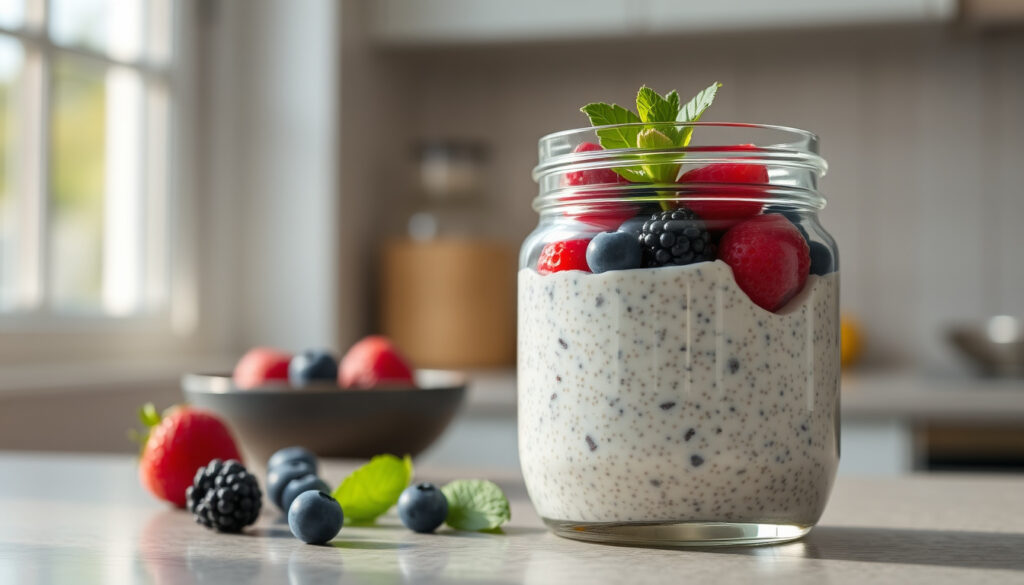
How to Make Overnight Chia: Step-by-Step Recipe & Health Benefits
Overnight chia pudding is one of those breakfasts that sounds too simple to actually work—mix seeds with milk, leave it in the fridge, and wake up to a creamy pudding. But behind that simplicity lies a surprising amount of science: chia seeds absorb up to 10 times their weight in liquid, turning into a gel that can keep you full for hours. Whether you’re looking for a low-histamine option or wondering if it really helps cholesterol, we cover everything from the perfect ratio to who should skip it.
Chia seed gel capacity: 10x water weight ·
Recommended liquid-to-seed ratio: 1:4 ·
Fiber per 2 tablespoons: 10 g ·
Minimum refrigeration time: 4 hours
Quick snapshot
- Chia seeds provide 10 g fiber and 5 g omega-3 ALA per 2-tablespoon serving (WebMD (consumer health resource))
- Gel formation increases fullness and reduces appetite (Harvard Health (academic medical publication))
- Long-term effect of chia seeds on triglycerides remains understudied (NCBI (biomedical research database))
- Chia pudding can be low in histamine when prepared with non-dairy milk and low-histamine toppings (The UltraWellness Center (functional medicine practice))
- Minimum soak: 4 hours; optimal: overnight (8-12 hours) (WebMD (consumer health resource))
- Store up to 5 days in the fridge (Dr. Green Mom (recipe blog))
- Experiment with low-histamine toppings: cooked berries, macadamia nuts (The UltraWellness Center (functional medicine practice))
- Combine with a sugar-free maple syrup for a no-spike sweetener
Six quick nutrition numbers, one takeaway: chia seeds pack a wallop of fiber and omega-3 in a tiny serving.
| Calories (2 tbsp) | ~140 |
| Fiber | 10 g |
| Protein | 4 g |
| Omega-3 ALA | 5 g |
| Gel capacity | 10x weight |
| Common liquid ratio | 1:4 seeds to liquid |
How do I make overnight chia seeds?
What milk and sweeteners work best?
- Dairy, almond, soy, and oat milk all work — use any unsweetened variety to control sugar
- Maple syrup, honey, or stevia are common sweeteners; for a low-histamine option stick with maple syrup or monk fruit
- Vanilla extract and a pinch of salt enhance flavor without added histamine
What is the ideal chia-to-liquid ratio?
- Use ¼ cup (4 tablespoons) of chia seeds to 1 cup of milk — a 1:4 ratio by volume (WebMD (consumer health resource))
- Stir well, wait 10 minutes, stir again to break up clumps, then refrigerate
- Minimum 4 hours; overnight (8-12 hours) yields the creamiest texture
That 15-minute re-stir is the single most important step. Miss it, and you’ll get clumps; do it, and the gel forms evenly — every time.
The implication: even a rushed morning prep (4 hours) still works, but patience rewards you with a smoother, pudding-like consistency.
Do chia seeds lower triglycerides?
Can chia seeds help high cholesterol?
- Chia seeds are rich in alpha-linolenic acid (ALA), an omega-3 linked to lower triglycerides
- A 2017 review in Nutrients found that daily chia consumption (30-50 g) modestly reduced LDL and triglycerides over 8-12 weeks (NCBI (biomedical research database))
- 10 g of fiber per serving helps bind cholesterol in the digestive tract (Prevention (health media outlet))
What flushes cholesterol out of your body?
- Soluble fiber (like that in chia) forms a gel that traps cholesterol and carries it out of the body
- Pair chia with oatmeal, flaxseed, or psyllium for a fiber-boosted breakfast
- Omega-3 ALA also supports healthy blood lipid profiles, though conversion to EPA/DHA is limited
The triglyceride-lowering effect is modest — not a substitute for statins or dietary fat reduction. Think of chia pudding as one tool, not a magic bullet.
The catch: chia alone won’t dramatically slash cholesterol, but as part of a high-fiber diet it’s a solid contributor.
Is chia pudding low in histamine?
What foods dump histamine?
- Chia seeds themselves are naturally low in histamine (The UltraWellness Center (functional medicine practice))
- High-histamine toppings (aged cheese, cured meats, fermented foods, leftover proteins) can trigger symptoms in sensitive individuals
- Safe additions: fresh or frozen cooked blueberries, blackberries, macadamia nuts, and maple syrup
The trade-off: the base is safe, but the topping choice makes or breaks a low-histamine breakfast.
What’s the best way to soak chia seeds overnight?
Is it OK to soak chia seeds overnight?
- Soaking reduces phytic acid, an antinutrient that can block mineral absorption
- Use a sealed mason jar or airtight container to prevent bacterial growth
- Refrigeration is mandatory — chia gel at room temperature can spoil
What not to mix with chia seeds?
- Avoid adding dry powders (protein powder, cocoa) before the chia has fully gelled — they clump
- Don’t soak chia in very acidic liquids (pure lemon juice, vinegar) for more than an hour; the gel may break down
- Never eat dry chia seeds — they can expand in the esophagus and cause choking
Why this matters: proper soaking is not just about texture — it’s a safety step that prevents digestive distress and choking hazards.
Who should not eat chia pudding?
Can chia seeds cause allergies?
- Rare but real: chia seed allergy can cause hives, swelling, or anaphylaxis (Verywell Health (consumer health website))
- Individuals with swallowing difficulties, esophageal strictures, or IBS should avoid dry chia and even well-soaked versions in large amounts
- High omega-3 may increase bleeding risk in people on blood thinners like warfarin; consult a doctor before adding large amounts
Chia pudding is a fantastic low-histamine breakfast for many, but for the handful of people with chia allergy or severe IBS, it’s off the table entirely.
The pattern: risks are low in prevalence but high in consequence — especially for those on blood thinners or with swallowing disorders.
Upsides
- High fiber (10 g per serving) supports digestion and heart health
- Complete plant protein with all nine essential amino acids
- Low histamine when made with safe toppings
- Keeps for 5 days — ideal for meal prep
Downsides
- Risk of constipation or blockage if eaten dry or under-hydrated
- Can cause gas and bloating in sensitive digestive systems
- Modest triglyceride effect — not a standalone treatment
- Rare but serious allergic reactions possible
Quick step-by-step: How to make overnight chia pudding
- Combine ¼ cup (4 tbsp) chia seeds and 1 cup milk in a jar or bowl.
- Stir thoroughly with a fork. Wait 10 minutes, then stir again to break up clumps.
- Add sweetener (maple syrup, honey, or stevia to taste) and a pinch of salt.
- Seal and refrigerate for at least 4 hours, preferably overnight.
- Top with fresh or cooked berries, nuts, or a drizzle of sugar-free maple syrup before serving.
- Store leftovers in the fridge for up to 5 days.
What we know vs. what’s unclear
Confirmed facts
- Chia seeds provide fiber and omega-3 ALA that support cholesterol management (Harvard Health (academic medical publication))
What’s unclear
- Long-term effect of chia seeds on triglycerides in human trials (NCBI (biomedical research database))
- Exact mechanism of histamine release in sensitive individuals (The UltraWellness Center (functional medicine practice))
- Chia pudding can be low histamine when prepared with non-dairy milk and low-histamine toppings (The UltraWellness Center (functional medicine practice))
Expert perspectives
“Chia seeds absorb 9 to 10 times their weight in water, so always use enough liquid and stir after 10 minutes to avoid clumps.”
— Ash Pryor, recipe developer (Dr. Green Mom)
“Eating too many chia seeds without enough liquid may cause severe constipation or, in extreme cases, a blockage.”
— Verywell Health (consumer health website)
“The gel that chia seeds form in the stomach increases fullness and decreases appetite — a natural tool for weight management.”
— Harvard Health (academic medical publication)
For the low-histamine breakfast seeker or the cholesterol-conscious eater, overnight chia pudding is a smart, evidence-backed choice. The base recipe is forgiving, the nutritional upside is real, and the risks are manageable — as long as you soak properly and choose your toppings wisely. For anyone in the U.S. juggling heart health and food sensitivities, the decision is clear: prep a batch tonight, or miss out on one of the simplest nutrient-dense breakfasts you can make.
For those new to this ingredient, it’s also worth exploring different ways to eat chia seeds to make the most of their nutritional benefits.
Frequently asked questions
Can I use almond milk for chia pudding?
Yes, unsweetened almond milk works well. It’s also a low-histamine option. Just ensure it’s fresh, not leftover from a previous meal, to keep histamine low.
How do you sweeten chia pudding without sugar?
Use stevia, monk fruit, or a small amount of maple syrup. For a sugar-free option, consider a sugar-free maple syrup.
Can I add fruit to overnight chia?
Yes, but for low-histamine diets, use fresh or frozen berries that are cooked (heated) to reduce histamine content. Avoid overripe or leftover fruits.
How long does chia pudding last in the fridge?
Up to 5 days in an airtight container. Stir before serving if separation occurs.
Can I freeze chia pudding?
Yes, but texture will be less creamy after thawing. Freeze in individual portions for up to 3 months.
Is chia pudding keto-friendly?
Yes, if you use unsweetened milk and a keto-approved sweetener like stevia. One serving has ~5 g net carbs (14 g carbs minus 10 g fiber).
More related posts
 Hooligan Hefs: Real Name, Songs, Net Worth, and Tour Info
 Lady Louise Windsor: Biography, Facts & Life Choices
 Adria Arjona: Biography, Movies, Relationship, and Languages
 Harry Kane: Speech Condition, Salary & Career Stats
 Dogs for Sale in Ireland: Trusted Listings & Buyer’s Guide
 Will Smith: Oscars Slap, Marriage, Health, and Comeback
 Daniel Sloss: The Comedian Behind the ‘Jigsaw’ Breakup Phenomenon
 Aged Pension Australia: Rates, Eligibility & Calculator 2026