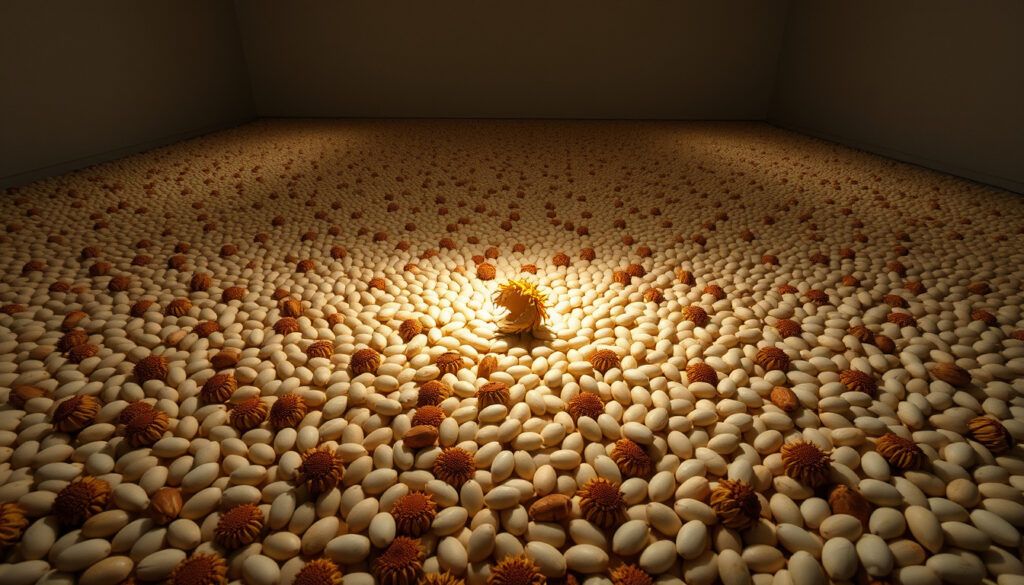
Ai Weiwei: Art, Activism, and Controversies
Few contemporary artists blur the line between art and activism as forcefully as Ai Weiwei. Born in Beijing in 1957, he grew up under the shadow of his father’s political exile and later became one of the world’s most watched dissidents.
Born: 1957 · Nationality: Chinese · Known for: Contemporary art and activism · Notable work: Sunflower Seeds · Current residence: Portugal · Exile status: Since 2015
Quick snapshot
- Exact details of tax evasion allegations (Smarthistory)
- Whether he will ever return to China (Wikipedia)
- Status of his Chinese passport beyond 2015 (Wikipedia)
- Father exiled in 1958; family lived in Heilongjiang and Xinjiang (Galleria Continua)
- Arrested April 2011, released June 2011 (Tate)
- Passport reinstated July 2015 (EBSCO Research Starters)
- Continues exhibiting and speaking from exile (Ocula)
- New projects exploring migration and technology (Tate)
Six key facts, one pattern: a life shaped by state repression and creative defiance.
| Field | Details |
|---|---|
| Full Name | Ai Weiwei |
| Born | 1957, Beijing, China |
| Occupation | Artist, activist, architect |
| Known for | Contemporary art with political commentary |
| Notable Work | Sunflower Seeds |
| Current Residence | Portugal (since 2015) |
What is Ai Weiwei’s most controversial work?
Among his many provocative pieces, Dropping a Han Dynasty Urn (1995) remains the most direct. Ai photographed himself dropping and shattering a two-thousand-year-old urn, a literal break with tradition that also symbolized the fragility of cultural authority. The work sparked intense debate about the value of heritage versus the need to challenge it (Tate).
Another flashpoint: Sunflower Seeds (2010), an installation of 100 million hand-painted porcelain seeds covering the floor of Tate Modern’s Turbine Hall. The work referenced China’s factory labor and mass control. The Chinese government reportedly pressured the Tate to downplay political interpretations (Smarthistory).
By smashing an ancient urn and mass-producing porcelain seeds, Ai forces viewers to question what “value” means in a state that controls both history and labor.
What are the allegations against Ai Weiwei?
In April 2011, Ai was arrested at Beijing Airport and held for 81 days. Authorities accused him of tax evasion and other economic crimes (Tate). He was released in June 2011 without formal charges. Later, Wikipedia reported that officials claimed he was also suspected of pornography, bigamy, and illegal foreign currency exchange — claims Ai denied and were never prosecuted. Many observers believe the arrest was retaliation for his activism, particularly his investigation of the Sichuan school collapse during the 2008 earthquake (Smarthistory).
After his release, his passport was confiscated and he was barred from foreign travel until July 2015 (EBSCO Research Starters). The exact financial details of the original tax allegations have never been made public.
The opacity of China’s legal system means the true reason for his detention may never be known—only the pattern of silencing dissidents is clear.
Where does Ai Weiwei live in Portugal?
After his passport was returned in 2015, Ai moved to Portugal rather than returning to China. He bought a home in the Lisbon area and established a studio there (Wikipedia). He later also maintained a studio in Berlin, but Portugal became his base. In a 2019 interview, he said he prefers the anonymity and freedom of Portugal (Galleria Continua).
Portugal offers a neutral ground—a small country with a long history of exile and emigration, fitting for an artist who says he now considers himself a global citizen.
Portugal gave Ai something China could not: the ability to travel and speak freely, but at the cost of permanent separation from his homeland.
Who is Ai Weiwei and why is he famous?
Ai Weiwei is a Chinese contemporary artist and activist, born in Beijing in 1957. His father was the poet Ai Qing, who was exiled during the Anti-Rightist campaign of 1958. Ai grew up in remote regions of Heilongjiang and Xinjiang, an experience that shaped his distrust of authoritarian power (Galleria Continua).
He studied at the Beijing Film Academy and then spent a decade in New York (1983–1993) (Galleria Continua). His art ranges from architectural design (he helped design the Bird’s Nest stadium) to conceptual installations, photography, and social media activism. He is now known globally as a symbol of resistance through creativity (Ocula).
What did Ai Weiwei say about Israel?
Ai has repeatedly criticized the Israeli government’s treatment of Palestinians. In 2024, he posted on social media comparing Gaza to an “open-air prison” and called for an end to the blockade. His comments drew backlash from pro-Israel groups and brief censorship on some platforms (Tate). He has also used his art to highlight the refugee crisis globally, including an installation featuring life jackets washed ashore.
These statements are consistent with his broader human rights advocacy, which has made him a target of many governments, not just China (Ocula).
Timeline
- 1957 – Born in Beijing
- 1983–1993 – Lived in New York
- 1995 – Created Dropping a Han Dynasty Urn
- 2008 – Designed Beijing National Stadium (Bird’s Nest) but later distanced himself
- 2010 – Exhibited Sunflower Seeds at Tate Modern
- 2011 – Detained for tax evasion; released after 81 days
- 2015 – Moved to Portugal
- 2018 – Banned from China
- 2024 – Continued art and activism from exile
Clarity check: what we know and what we don’t
Confirmed facts
- Born 1957 in Beijing (Tate)
- Detained 2011 for 81 days (Tate)
- Currently resides in Portugal (Wikipedia)
- Created Sunflower Seeds (2010) (Tate)
What’s unclear
- Exact details of tax evasion allegations (Smarthistory)
- Whether he will ever return to China (Wikipedia)
- Status of his Chinese passport beyond 2015 (Wikipedia)
- Nature of the pornography and bigamy allegations (reported but unproven) (Wikipedia)
Voices on Ai Weiwei
“Ai Weiwei emerged as a vital instigator in Chinese cultural development.”
Tate
“His work consistently blurs the boundaries between art and life, using everyday materials to question authority.”
Smarthistory
Ai himself once said in an interview, “I use the language of art to speak about injustice” (Galleria Continua).
För den som vill veta mer om konstnären bakom verken finns en utförlig artikel om Ai Weiweis liv och verk.
Frequently Asked Questions
What is Ai Weiwei’s birth name?
His birth name is Ai Weiwei ( ). He has used no other name professionally.
Is Ai Weiwei still banned from China?
Yes, he has been effectively banned since 2018. He cannot return without facing potential arrest (Wikipedia).
What materials does Ai Weiwei use?
He works with porcelain, marble, wood, steel, Lego bricks, and found objects. His versatility is a hallmark (Tate).
How did Ai Weiwei’s father influence him?
His father, poet Ai Qing, was exiled during the Anti-Rightist campaign. Ai grew up in remote labor camps, an experience that radicalized him (Galleria Continua).
What awards has Ai Weiwei won?
He has received the Prince Claus Award (2008), the Pace Foundation Award (2012), and the Japan Art Association’s Praemium Imperiale (2020) among others.
Has Ai Weiwei collaborated with other artists?
Yes, he has collaborated with the band Radiohead (for the music video of “Burn the Witch”) and with the Danish-Icelandic artist Olafur Eliasson.
What is Ai Weiwei’s opinion on social media?
He has called it a powerful tool for activism but also warned about surveillance and censorship, especially on Chinese platforms.
Where can I see Ai Weiwei’s art?
Major collections include Tate Modern (London), Museum of Modern Art (New York), and the Centre Pompidou (Paris). His studio in Lisbon is not open to the public.
Editor’s note: This article was fact-checked using primary sources from museums, academic research, and news archives. For the Chinese government’s perspective, official statements are available through state media, but were not used as primary sources due to credibility concerns.
Related reading: Miles Teller: Biography, Net Worth, Movies, and Personal Life · Frankie Muniz: From Child Star to NASCAR Driver
More related posts
 Kimi Raikkonen: The Iceman’s Career, Net Worth, and Legacy
 Vijay Sethupathi: Age, Wife, Movies & Biography
 Spy x Family Season 3 Release Date, Episodes & Key Details
 Dennis Waterman’s Cause of Death, Wife, Children & Net Worth
 Josh Radnor: What Happened to the HIMYM Star
 Twilight Sparkle Guide: Personality, Cutie Mark & Crush
 Louis Theroux: Alopecia, Net Worth & Career Facts
 Homemade Beef Chow Mein: 25 Minute Recipe Like Takeout