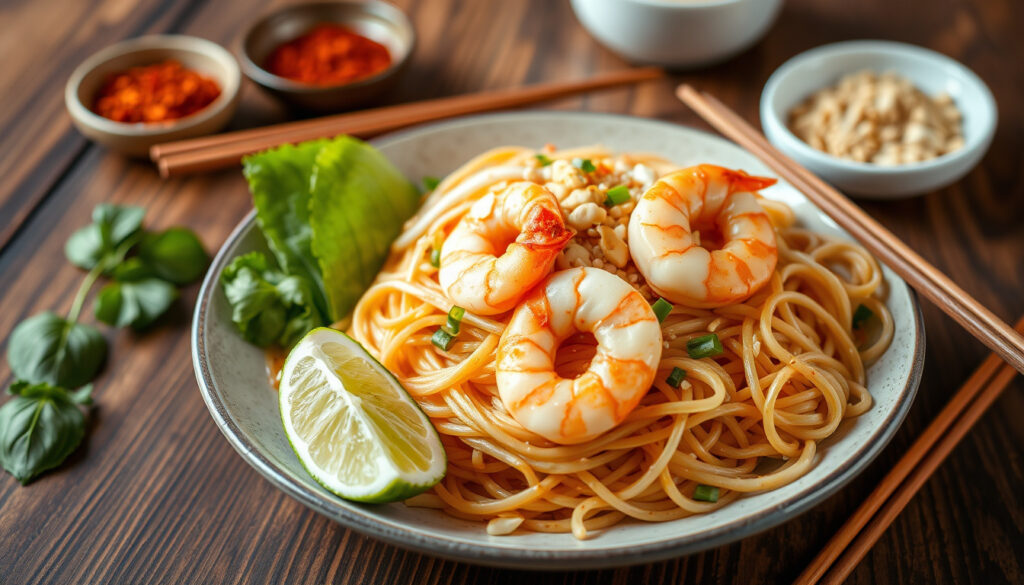
Pad Thai Noodle : Type , Ingredient , and Health In ight
There’s a moment in any good Thai kitchen—the sizzle of a hot wok, the tang of tamarind hitting the air—that makes you wonder exactly what gives those noodles their signature chewy-yet-tender bite. That slim, flat rice noodle called sen lek is the quiet workhorse behind every plate of Pad Thai, and getting to know it unlocks more than just a recipe.
Noodle type: Flat dried rice noodles (sen lek), 3–5 mm wide ·
Key ingredients: Tamarind paste, fish sauce, palm sugar, lime, peanuts, bean sprouts ·
Calories (per serving): Approximately 600–800 calories ·
Protein: 15–20 g per serving (with chicken or shrimp) ·
Carbohydrates: 80–100 g per serving ·
Gluten: Naturally gluten-free when using rice noodles
Quick snapshot
- Sen lek – 3–5 mm flat rice noodles (RecipeTin Eats)
- Also called rice stick noodles (BBC Good Food)
- Available dried in most supermarkets (RecipeTin Eats)
- Tamarind paste (Hot Thai Kitchen)
- Fish sauce, palm sugar, lime (Hot Thai Kitchen)
- Peanuts, bean sprouts (RecipeTin Eats)
- ~700 calories per serving (RecipeTin Eats)
- High in carbs (80–100 g) (Diabetes UK)
- Gluten-free (RecipeTin Eats)
- Moderate protein if added (RecipeTin Eats)
- Soak in warm water, not boiling (Hot Thai Kitchen)
- Stir-fry fast over high heat (El Mundo Eats)
- Add noodles last to avoid mushiness (Life Made Sweeter)
What kind of noodles are used in Pad Thai?
Pad Thai’s noodle is a flat, dried rice noodle known in Thai as sen lek. It’s the same ingredient you might find labelled “rice stick noodles” in Western supermarkets. Unlike the round, spaghetti-like rice vermicelli (sen mee) or the wide, almost fettuccine-width noodles (sen yai), sen lek occupies a middle ground: thin enough to soak up sauce quickly, wide enough to hold texture during a searing hot stir-fry.
A home cook shopping for “stir-fry rice noodles” who picks up sen yai (extra wide) instead of sen lek ends up with a dish that flaps rather than curls — and absorbs sauce unevenly. The correct width directly affects whether the dish tastes like takeout or a compromise.
Characteristics of sen lek noodles
Sen lek noodles are made from rice flour and water, dried into brittle, flat strands. Once rehydrated they become pliable, translucent, and slightly chewy.
Key trait: A single serving (about 2 ounces dry) expands to roughly a cup of cooked noodles.
The RecipeTin Eats (established recipe developer) describes them as “thin, flat rice noodles” — a hallmark of the dish. BBC Good Food (UK culinary authority) confirms the noodle type as “flat, dried rice noodles called sen lek,” noting their traditional width of 3–5 mm.
Thickness and width of rice sticks
Thickness varies slightly by brand and region. El Mundo Eats (specialist recipe site) recommends noodles about 1/4-inch (roughly 6 mm) wide; Two Kooks In The Kitchen (cookbook-focused blog) uses a thinner 2–3 mm width. The difference matters: wider noodles hold up slightly better to heavy sauce, while thinner ones curl more easily and cook faster. Most Thai street vendors use the 3–5 mm standard — it’s the sweet spot between chew and sauce absorption.
Alternative names for Pad Thai noodles
You’ll encounter these labels at the store or online:
- Rice stick noodles — the most common English name (RecipeTin Eats)
- Sen lek — the Thai term
- Banh pho — the Vietnamese name for the same noodle used in pho (close cousin, slightly wider in some brands)
- Stir-fry rice noodles — a generic retail label
The trade-off: not a single brand name to memorize, but the shape and width are the real identifiers. When a package says “thin flat rice noodles” or “pad thai noodles” you’re in the right lane.
What are the ingredients in Pad Thai?
Pad Thai’s flavour comes from a tight balance of sweet, sour, salty, and savoury — a combination that depends on a few non-negotiable ingredients. Swap tamarind for ketchup or palm sugar for brown sugar, and the dish collapses into a different thing entirely.
Essential sauce components
The sauce is where the magic lives. Hot Thai Kitchen (Thai cooking authority) calls out a sauce built from tamarind paste (sour), fish sauce (salty), and palm sugar (sweet). Lime juice brightens the finish. That’s it — four ingredients, no complicated ratios. Some Western adaptations replace tamarind with lime juice and brown sugar, but purists warn the depth disappears.
A few other less-discussed players: preserved radish (chai poh) adds a salty-fermented punch, and dried shrimp contributes umami without overpowering. Hot Thai Kitchen lists “preserved radish, dried shrimp, garlic, shallots, tofu, eggs, bean sprouts, garlic chives, and peanuts” as a traditional-style lineup.
Protein options
- Chicken — most common, mild flavour
- Shrimp — traditional street-style choice
- Tofu — classic vegetarian option, often firm or pressed
- Egg — scrambled into the noodles themselves
RecipeTin Eats confirms that the dish “usually contains bean sprouts, garlic chives, scrambled egg, firm tofu, and a protein.” The egg gets scrambled in the wok after the sauce is mostly absorbed, coating the noodles in bits of custard-like richness.
Garnish and crunch
Crushed peanuts, fresh bean sprouts, and lime wedges are the classic finish. RecipeTin Eats notes that “lime wedges are commonly served with Pad Thai for squeezing over the finished dish.” Garlic chives (or scallions where chives are hard to find) add a gentle oniony edge. The textural contrast — crunchy nuts, crisp sprouts, soft noodles — is what keeps each bite interesting.
Is Pad Thai Healthy?
Nutritionally, Pad Thai is a carb-forward dish with moderate protein and plenty of vegetables. Whether it’s “healthy” depends entirely on portion size, protein choice, and what else you eat that day.
Caloric and macronutrient breakdown
A typical restaurant serving of Pad Thai clocks in at roughly 600–800 calories, with 80–100 grams of carbohydrates and 15–20 grams of protein if chicken or shrimp is included. Fat comes primarily from the oil used in stir-frying and the peanuts — expect around 25–35 grams. The rice noodle base is the main driver of the carb load.
Six key nutrition facts, one pattern: moderate protein, high carb density:
| Nutrient | Per serving (~350 g) | % Daily Value (2,000 cal) |
|---|---|---|
| Calories | 600–800 | 30–40% |
| Carbohydrates | 80–100 g | 27–33% |
| Protein | 15–20 g | 30–40% |
| Fat | 25–35 g | 32–45% |
| Fiber | 2–4 g | 8–16% |
| Sodium | 800–1,200 mg | 35–52% |
Micronutrient highlights
- Vitamin C from lime and bean sprouts
- Iron from tofu and eggs
- Magnesium from peanuts
- Vitamin K from garlic chives
The catch: Pad Thai isn’t a calcium or vitamin D source, and the sodium content can be surprisingly high due to fish sauce and salt in the noodles.
Health considerations
Pad Thai is naturally gluten-free when made with rice noodles — a strong selling point for gluten-sensitive eaters. For most people, the main watchpoints are total calories and carb load. A half-portion paired with a side of vegetables or a broth-based soup creates a more balanced meal.
A standard Pad Thai serving packs nearly half the daily carb allowance for a moderately active adult. For someone managing weight or blood sugar, the portion is the pivot: halve it, or share it.
Is Thai food good for diabetics?
Thai cuisine isn’t inherently bad for diabetics — but Pad Thai sits on the higher-risk end of the spectrum because of its rice noodle base and sugar-laced sauce.
Glycemic impact of Pad Thai
The high carbohydrate load in Pad Thai (80–100 g per serving) can cause a rapid blood sugar spike, especially if eaten alone without protein or fiber. Diabetes UK (leading diabetes charity) advises that rice noodle dishes should be eaten in moderation due to their effect on blood glucose levels. The presence of peanuts and optional protein (chicken, shrimp, tofu) slows digestion slightly, reducing the peak — but the carb number remains high.
The 3-hour rule in diabetes
Some diabetes management guidelines suggest a “3-hour rule” between carbohydrate-heavy meals — meaning at least 3 hours between finishing one carb-dense dish and starting another, to allow blood sugar to stabilise. Pad Thai, by this measure, qualifies as a meal that triggers that timer. Research in the journal Nutrients (academic medical journal) confirms that spacing carbohydrate intake by 3–4 hours can improve postprandial glucose response in people with type 2 diabetes.
Healthier Thai dish alternatives
- Larb — minced meat salad with herbs, low carb
- Grilled meats — satay or moo ping, protein-focused
- Tom yum soup — shrimp soup with lemongrass, low carb
- Yum nua — spicy beef salad, vegetable-forward
Diabetes UK recommends choosing “grilled, steamed, or stir-fried dishes with plenty of vegetables and lean protein” over noodle-heavy options. The pattern: skip the rice and noodles, double the vegetables and lean meat.
How do you cook Pad Thai noodles?
Cooking Pad Thai noodles is simple in theory but easy to botch in practice. The enemy is overcooked, mushy noodles that clump into a starch brick. A few precise steps prevent that.
Preparing rice noodles
- Soak the dried rice noodles in room-temperature water for about 1 hour, or in hot (not boiling) water for 5–10 minutes until just soft and bendable at the core.
- Optional: cut the dry noodles in half before soaking to make them easier to toss and separate in the wok.
- Drain well. The noodles should be pliable but still slightly firm — they’ll finish cooking in the wok.
Hot Thai Kitchen (Thai cooking authority) endorses the room-temperature soak method, while RecipeTin Eats (established recipe developer) offers the hot-water shortcut. Both agree: never boil the noodles.
Stir-frying technique
- Heat a wok or large pan over high heat until smoking.
- Add oil, then aromatics (garlic, shallots).
- Add protein, cook through, then remove or push aside.
- Add drained noodles and sauce, toss quickly.
- Push noodles to one side, scramble eggs in the empty space.
- Fold eggs into noodles, add bean sprouts and chives, remove from heat.
El Mundo Eats (specialist recipe site) stresses cooking over high heat in a wok or wide pan to achieve wok hei. If you don’t have a wok, a large stainless steel or carbon steel pan works — avoid non-stick, which can’t reach high temperature without degrading.
Avoiding mushiness
The single biggest mistake: overcooking the noodles before they hit the wok. Life Made Sweeter (authoritative recipe site) warns that “overcooking rice noodles makes Pad Thai soggy or causes the noodles to break apart.” The fix: under-soak rather than over-soak. If they’re still a little stiff when you drain them, they’ll finish perfectly in the wok. Hot Thai Kitchen adds that bean sprouts and garlic chives should go in “off the heat or with residual heat” — they need just a moment of warmth to wilt, not a full sauté.
The home cook who boils the noodles like pasta will get glue. The cook who soaks them until just pliable and finishes them in screaming-hot oil gets the chewy, separate strands that define a great Pad Thai.
“Flat, dried rice noodles called sen lek are used in a pad Thai. Traditionally, these are 3–5 mm.”
— BBC Good Food (UK culinary authority)
“Pad Thai is a Thai noodle stir fry with a sweet-savoury-sour sauce scattered with crushed peanuts. It’s made with thin, flat rice noodles.”
— RecipeTin Eats (established recipe developer)
For those looking to try their hand at making this dish, following an authentic pad thai recipe ensures the perfect balance of sweet, sour, and savory flavors.
Frequently asked questions
Can I use other noodles for Pad Thai?
Yes, but it won’t be authentic Pad Thai. Rice vermicelli (sen mee) is too thin and will overcook. Egg noodles or udon change the texture significantly. For a gluten-free alternative that mimics the chew, soba noodles are the closest option — though the flavour will be slightly different.
Is Pad Thai gluten-free?
Yes, when made with 100% rice noodles. The main sauce ingredients (tamarind, fish sauce, palm sugar) are naturally gluten-free. However, some bottled fish sauces may contain wheat — check the label. Vegetable oyster sauce (mushroom-based) is a safe alternative for those with celiac.
How many calories are in Pad Thai?
A restaurant serving averages 600–800 calories. Homemade versions can come in lower (400–550) by reducing oil and using chicken breast instead of fried tofu. The biggest calorie source is the oil and the rice noodles themselves.
What is the healthiest protein to add to Pad Thai?
Grilled chicken breast or shrimp provide the highest protein-to-fat ratio. Tofu is a good plant-based option but check whether it is fried — fried tofu adds significant calories. Egg whites (without yolk) can also increase protein with minimal fat.
Can diabetics eat Pad Thai in moderation?
Yes, with portion control. A half-portion (300–400 calories) with added protein and vegetables can fit a diabetic meal plan. The 3-hour rule between carb-heavy meals helps stabilise blood sugar. Avoid large takeaway servings.
Where can I buy authentic Pad Thai noodles?
Asian grocery stores carry them under brands like Erawan, Dragonfly, or Three Ladies. “Rice stick noodles” is the shelf label. Check the width — look for “thin” (about 3–5 mm) specifically for Pad Thai. The same noodle in wider form is for pho.
How do I prevent Pad Thai noodles from clumping?
Soak them in room-temperature water, not boiling water. Drain well before adding to the wok. Toss with a splash of oil if they sit for more than a minute. Use high heat and keep them moving — low heat causes starch to release and sticks them together.
For the home cook in the US or Australia reading this, the choice is straightforward: use wide rice sticks and you’ll get a passable stir-fry, not a Pad Thai. The 3–5 mm sen lek is worth seeking out. For diabetics and calorie-counters, the same noodle in a smaller portion (half the takeaway box) lets you enjoy the dish without the spike. And for anyone who’s ever stared at a bag of dried rice noodles wondering why the recipe didn’t work — it was almost certainly the soak.
Related reading: Homemade Beef Chow Mein: 25 Minute Recipe Like Takeout · Chinese Near Me: Top Dishes, Healthy Options & Local Tips
More related posts
 Plane Crash Today: Pacoima Incident, LaGuardia Collision Latest
 Mighty Mouse: Demetrious Johnson’s UFC Career & Retirement
 Brett Tucker: Biography, Career, and Current Projects (2024)
 Proud Poppy Clothing: Owner, Size , Ethic , and Review
 M to Ft: Exact Meters to Feet Formula & Conversion Table
 Frankie Muniz: From Child Star to NASCAR Driver
 Tom Liberatore: AFL career, pub owner, father & injury return
 Scott Adkins: Martial Artist, Actor and Friend to Jason Statham